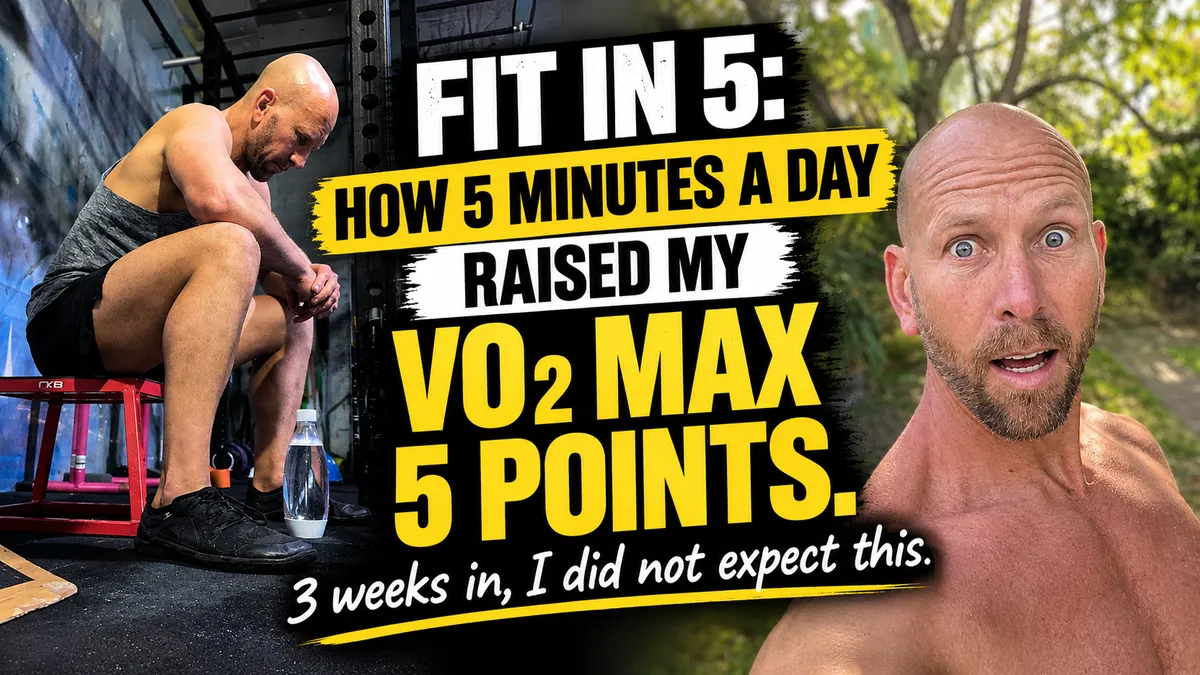
Fit in Five: 5 Minutes a Day Raised My VO2 Max 5 Points
KEY TAKEAWAYS
Fitness is rented, not owned. Eleven weeks of missed mornings took my VO2 max from 47 to 38.3, and not one of those mornings felt like a decision.
Five minutes a day of intervals moved it from 38.3 to 43.2 in three weeks. Fifteen seconds hard, forty-five seconds easy, five rounds.
When time is short, intensity does the work duration would otherwise do. Small does not mean gentle. It means short.
Some of that gain is reclaimed ground rather than new ground, and the curve will flatten. Both things can be true.
Nothing else changed. No diet overhaul, no extra gym sessions, no sleep fix, still doing the early drives.
The format is designed to stack. Fit in Five, then Strong in Five, then Flexible in Five. Fifteen minutes covering the engine, the chassis and the hinges.
Fit in Five: 5 Minutes a Day Raised My VO2 Max 5 Points
Three weeks into an experiment I did not want to have to run twice. Here is the protocol, the actual numbers, and what I reckon it says about the size of change that sticks.
My son finished school this year and got himself a job. Good news. Proud dad. What nobody warns you about that particular milestone is that it arrives with a roster, and the roster does not give a stuff about your morning routine. So most days now I am in the car at an hour that used to belong to me, windscreen fogged, heater rattling, driving across the suburbs and back before the sun has properly committed to the day.
That drive cost me my run. There was no injury. No crisis. Nothing worth telling anyone at a barbecue. Just a slow leak, the kind you miss because every individual day looks completely reasonable on its own.
Eleven weeks later I checked the number. My VO2 max had dropped from 47 to 38.3.
I sat in the car park and stared at it for a while. I am a personal trainer. I get paid to stop people doing precisely what I had just spent eleven weeks doing.
What is VO2 max, and why should you care about it?
VO2 max measures how much oxygen your body can take in, move around, and actually use when you are working hard. It is the size of your engine. A bigger number means you climb the stairs, carry the shopping, chase the grandkid, or get through a brutal Tuesday with more left in the tank.
It is also one of the more useful numbers in health. Low cardiorespiratory fitness tracks with a higher risk of dying of more or less everything, and the biggest jump in risk sits between the bottom group and the one just above it. You do not need to be an athlete. You need to not be stuck in the bottom bucket.
Worth saying plainly before we go further: the figures I am quoting are wearable estimates, not a lab test with a mask strapped to my face. Estimates drift. What matters is the trend line, measured the same way, over time. Treat the absolute number as a rough guide and the direction as the real information.
A few years ago, mine was 36
For a bloke in his forties, 36 is not a catastrophe. For a personal trainer who has built most of his adult identity around being better than average physically, it was embarrassing. I was fit in all the ways you can see. Strong enough. Lean enough. And my engine was small.
Here is my problem. I hate cardio. Not in a coy, self-deprecating, "oh I am just not a runner" way. I find long steady state cardio boring in a way that makes my skin itch. Forty-five minutes on a treadmill is my personal hell. On top of that I had no spare time and no interest, which is a fairly ordinary foundation for a training program.
So I made a deal with myself. Five minutes. Every day. Out the door, run, come back. Five minutes is too short to negotiate with. It is too short to be worth dreading. It is shorter than the time I would have spent talking myself out of a proper session.
Running still sucked. It sucked on day one and it sucked on day two hundred. But five minutes of something I hate is survivable in a way that thirty minutes of it never was.
Over a long stretch of doing that almost daily, my VO2 max went from 36 to 50.
Fifty. Off five minutes.
How do you lose nine points in eleven weeks?
Easily, is the answer. A lot faster than you build them.
Fitness is not something you own. It is something you rent, and the rent falls due daily. Your body is relentlessly practical. It maintains exactly as much machinery as you give it a reason to maintain and not one bit more. Plasma volume, mitochondrial density, stroke volume, capillary networks: all of it is expensive to run, and all of it gets scaled back the moment the demand stops.
Eleven weeks of driving instead of running took me from 47 to 38.3. Most of the way back to where I started, undone by a run of mornings that each looked completely defensible at the time.
That is the part I want you to sit with. Nobody decides to lose their fitness. There is no moment where you choose it. It walks out through a door you left open because you were busy being a good parent, or a good employee, or just knackered.
What fifteen years with animals taught me about five minutes
Before I coached people I was a zookeeper. Fifteen years of it, wedge-tailed eagles through to Asian elephants.
You do not train an elephant by asking it to do the thing. You would be waiting forever and you would probably get hurt. You shape it. You reward an approximation so small it looks like nothing at all: a shift of weight, a glance in the right direction, one foot moved four inches. Then you build on that, and build again. The finished behaviour, the one that looks impressive to a crowd, is a stack of hundreds of tiny approximations nobody ever saw.
We treat humans completely differently. We hand people the finished behaviour on day one. Six sessions a week. Meal prep on Sunday. Eight hours of sleep, tracked. Then we act surprised when they fall over by Wednesday and decide, privately, that they lack discipline.
You do not lack discipline. You were handed the last step of a process and told to start there.
Five minutes is the approximation. It is the foot moved four inches. It looks like nothing, and it is the only part of this you have real control over.
So I started again, and this time I am documenting it
I have called it Fit in Five, because I am not clever and it does what it says.
The protocol, in full: five rounds of fifteen seconds hard, forty-five seconds easy. Five minutes, start to finish.
No equipment. No gym. The hard fifteen seconds can be anything that lifts your heart rate quickly and safely for you. Running on the spot. Star jumps. A sprint. Stairs. A bike or a rower if you own one. The only rule is that the fifteen seconds should feel properly uncomfortable by the end of it, and the forty-five seconds should be.... nothing. There is nothing else to it.
Three weeks in, here is where it sits
Starting point: 38.3. Three weeks later: 43.2.
Just under five points in twenty-one days, off five minutes a day. When I saw it I said something out loud that I am not going to write down here.
Now the honest caveats, because I would rather be useful than impressive.
First, regaining lost fitness is faster than building it the first time. My body has been here before. Previously trained tissue comes back quicker than it was originally built, so a decent chunk of those five points is me reclaiming ground I already paid for once.
Second, three weeks is nothing. It is a data point, not a study. Sample size: one bloke with a watch.
Third, the curve will flatten. It always does. Getting from 38 to 43 is a different job to getting from 47 to 50, and I fully expect the next five points to cost me a hell of a lot more than fifteen days.
I also want to be straight about what I have not changed. I did not overhaul my diet for this. I did not add gym sessions, buy anything, or fix my sleep. I kept living the life that caused the drop in the first place, right down to the early drives, and I added five minutes. That is deliberate. If the only way a thing works is by rearranging your entire existence around it, it is not a thing most people can use.
None of that changes the thing I actually find interesting, which is the ratio. Five minutes is about a third of one percent of a day. For that, I am getting measurable movement in a number that predicts how long I stay healthy and useful.
Why does five minutes work when an hour does not?
Mostly because I actually do it.
That is less of a joke than it sounds. The best training program on earth has a completion rate of zero if it cannot survive contact with your real life. Most programs are built for a version of you who has a spare hour, a clear head, and nothing going wrong. That version of you turns up about four times a year.
Five minutes survives contact. It survives a bad night of sleep. It survives a work crisis, a sick kid, a 6am drop-off. There is no decision to make, no bag to pack, no travel time, no negotiation. By the time your brain has produced a halfway decent excuse, you are two rounds in and it is nearly over.
There is a second thing going on, and it is physiological rather than psychological. Short, hard intervals are efficient at driving the specific adaptations that lift VO2 max. Brief repeated efforts at high intensity push stroke volume and oxygen delivery in a way that comfortable jogging simply does not. When the time available is small, intensity does the work that duration would otherwise do. That is why fifteen seconds on and forty-five off can shift a number most people assume requires hours of steady state.
There is a third reason, and it is the one I see wreck people most often. Nearly everyone I coach has a Monday problem. They start hard on Monday with good intentions, they are still going Tuesday, and by Wednesday something has gone sideways and the whole thing is off. Then they wait for the next Monday. Half their year gets spent in that loop, and every failed attempt makes the next one feel heavier. Five minutes breaks the loop because there is no version of your Wednesday that cannot accommodate it. You stop having a restart problem because you never actually stop.
Small does not mean gentle. It means short.
The part that actually interests me is that it stacks
Here is where this stops being a story about cardio.
If five minutes a day can move VO2 max, the obvious question is what else moves on five minutes a day.
So Fit in Five is the first of three. Strong in Five comes next, five minutes of strength work built on the same logic. Then Flexible in Five, five minutes of mobility. Stack all three and you have fifteen minutes a day covering the engine, the chassis and the hinges.
Fifteen minutes. One percent of your day.
I am not going to pretend I have finished building this or that I know exactly how it will look by Christmas. I am three weeks into the first one. It is very much a work in progress, and I will keep publishing the numbers as they come, including the flat weeks and the ones where the line goes the wrong way.
What to do with this, if you want to
Pick one thing. Make it five minutes. Do it daily rather than doing it well.
If you are deconditioned, your fifteen seconds might be walking briskly up a slope, and that is completely fine. Intensity is relative to you, not to me and not to anyone on the internet. If you have a heart condition, a joint that already complains, or you have not done anything genuinely hard in years, have a conversation with your GP before you start throwing yourself at intervals.
Then measure something. A watch estimate, a six minute walk test, how you feel at the top of the stairs at work. Retest every eight to twelve weeks rather than every day. Daily numbers are noise, and noise makes people quit.
And then just keep turning up. The change you can sustain beats the change that looks impressive on paper, every single time.
I will report back in three weeks. Watch this space...
FAQ'S:
What is a good VO2 max for a man in his forties?
Roughly speaking, the low thirties is below average, the high thirties to mid forties is around average to good, and anything north of the high forties is strong for that age group. I would not get too precious about the exact bracket. The useful question is which direction yours is heading, because the biggest health gain sits in moving off the bottom rung, not in chasing an elite number.
Can you really improve VO2 max in five minutes a day?
Mine went from 38.3 to 43.2 in three weeks on five minutes a day, so yes, at least from a deconditioned starting point. Short, hard intervals drive the adaptations that lift VO2 max efficiently. The catch is that some of my gain is reclaimed fitness rather than new fitness, and progress slows down the fitter you get. Five minutes is a floor that works, not a magic number.
How accurate is the VO2 max reading on a watch?
It is an estimate, not a lab test. Wearables work it out from heart rate and pace, so the absolute number can be out by a fair margin. What it is genuinely good at is showing a trend when you measure the same way on the same device over weeks. Judge the direction, not the digits.
How quickly do you lose VO2 max if you stop training?
Faster than you built it. Plasma volume drops within days, and stroke volume and mitochondrial adaptations follow over the weeks after. I lost nearly nine points in eleven weeks without doing anything dramatic, just by losing my morning window. The upside is that it comes back quicker the second time, because your body has been there before.
What is the 15 seconds on, 45 seconds off protocol?
Five rounds of fifteen seconds hard and forty-five seconds easy. Five minutes total. The fifteen seconds should feel properly uncomfortable by the end and the forty-five should be genuinely easy. No equipment required. Running on the spot, star jumps, stairs, a steep walk, a bike or a rower all work.
Do you have to run to improve your VO2 max?
No. Your heart and lungs cannot tell what your legs are doing. They respond to the demand, not the activity. I run because it is the fastest way for me to get my heart rate up with nothing but shoes, and I still do not enjoy it. Use whatever you will actually do, especially if your knees or your patience have opinions about running.
How often should you retest?
Every eight to twelve weeks. Daily numbers are noise, and noise makes people quit. If you want something simpler than a watch, a six minute walk test or a two minute step test will track your trend just fine, and they are far better options if you are older, carrying an injury or starting from a low base.
Is five minutes a day enough if you are starting from scratch?
If you are starting from scratch it is arguably the best place to begin, because the biggest health returns come from getting off the bottom rung and the main thing standing in your way is consistency. Scale the intensity to you. Your fifteen seconds might be a brisk walk up a slope. If you have a heart condition, a cranky joint or you have not done anything hard in years, talk to your GP first.