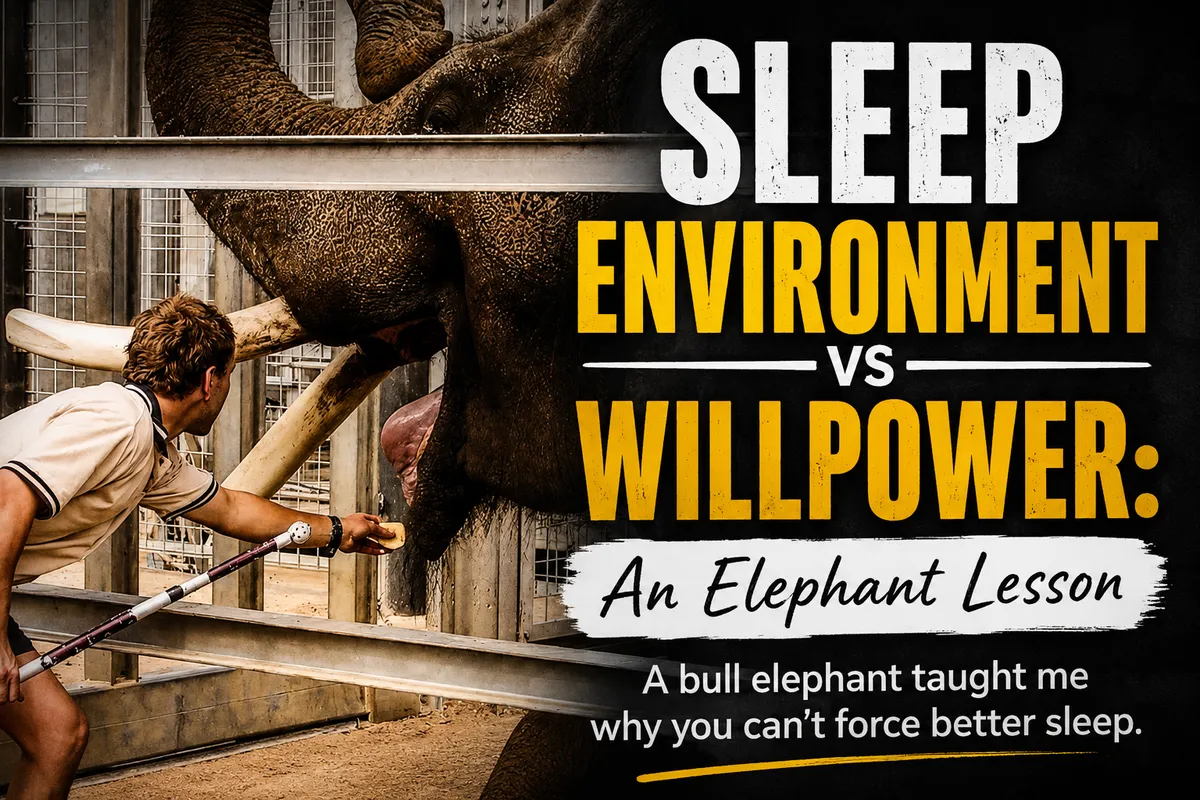
Sleep Environment vs Willpower: An Elephant's Lesson
Stop trying to discipline your way to better sleep. A tired body recovers when the conditions let it, not when you try harder.
Build a runway, not a switch. Give yourself fifteen minutes of wind-down with dim lights and no phone before you expect to drop off.
Get the racing thoughts out of your head and onto paper. A notepad by the bed beats lying there trying to hold your whole to-do list in your skull.
Make your bedroom properly dark, cool and quiet. Your body reads these signals automatically, whether you mean it to or not.
Get your phone out of the bedroom entirely. It's the single biggest disruptor in most people's sleep environment.
Keep your bed for sleep only. Working, scrolling or watching telly in bed teaches your brain the space is for staying switched on.
Drop the 3am maths. Calculating how wrecked you'll be tomorrow is what keeps you awake, not the wake-up itself.
If you're still awake after twenty minutes, get up. Go to another room, keep the lights low, and go back only once you feel sleepy.
Recover in the day when the night falls apart. Ten minutes of non-sleep deep rest, eyes closed, phone away, is a genuine top-up.
Sort caffeine and alcohol before you buy a supplement. Cutting coffee after lunch will do more for your sleep than most bottles on a shelf.
Treat supplements as the last five percent, not the fix. Magnesium is a reasonable low-risk start; talk to your GP before trying melatonin.
Sleep Environment vs Willpower: An Elephant's Lesson
Eight years with a bull elephant named Bong Su showed me the same thing I now tell every burnt-out client. Rest runs on environment, not discipline.
For close to eight years I worked with a bull elephant named Bong Su. I washed him. I trimmed his nails. I exercised him. I even painted pictures with him, which sounds made up but genuinely isn't. Over those years I became one of the very few people he trusted to get in that close, and with an animal that size, that kind of trust isn't a small thing. It's earned slowly, over a long stretch of time, and there's no faking it.
For a big chunk of that time, his body was letting him down. Sore feet. Arthritis. The kind of joint pain that doesn't take a day off, ever. For years, everyone chalked it up to age. Old elephant, old joints, not much you can do. And sure, age played its part. But the real problem wasn't his age. It was the floor.
The old exhibit was hard concrete. Nowhere soft to lie down, no water to float the weight off, no real room to move the way an elephant's body is built to move. So you've got a genuinely enormous animal standing on a hard surface, day after day, year after year, and all that wear and tear has nowhere to go. It builds up. It turns chronic. No amount of toughness on Bong Su's part was ever going to fix a problem that was built into the ground under his feet.
You Can't Discipline Your Way to Better Sleep
Then the zoo spent around thirteen million dollars on a new enclosure. Pools. Sand hills. Space to actually explore. Somewhere soft to lie down and something a lot kinder than concrete to stand on. And I watched him change. He rested properly in the day. He slept properly at night. He got in the water and took the load off those sore feet. He lived out the rest of his life healthy, and about as content as an old elephant gets. Same elephant, same age, same dodgy feet. The only thing that actually changed was the environment around him, and once that was right, his body finally got to do the thing it had been trying to do the whole time. Recover.
That's the whole point of everything I'm about to tell you, and it's the thing most sleep advice skips straight past. You cannot push your way to better sleep. You cannot discipline your way there either. A tired body recovers when the conditions let it, and it stays stuck when they don't, exactly like the elephant. Try as hard as you like, but if the setup is working against you, you'll stay tired. Get the setup right, and rest stops being a fight you have to win every night.
Why Can't You Fall Asleep Even When You're Exhausted?
Here's something most people don't know about elephants. They don't lie down to sleep unless they feel safe. An animal that big, lying flat on the ground, is an animal that's vulnerable, so out in the world they only do it when everything feels right, and even then, not for long. In that old concrete exhibit, Bong Su barely did it at all. He'd doze on his feet. Never really went under.
When the new enclosure came, with the soft sand and the space and a setup that actually felt secure, I watched him lie right down on his side and properly sleep. Full body, flat out, gone. The first time I saw it, it stopped me, because I knew exactly what it meant. He finally felt safe enough to let go.
Your body is running the same program. It will not drop into good sleep while some part of it still thinks it needs to stay on guard. You can be dead tired, lying in the dark, desperate for sleep, and still wide awake, because you're braced, still on your feet in every way that matters. Most of the time, the thing keeping you braced is a head that won't stop going. The day's still running laps in there, tomorrow's list, that conversation, the thing you forgot to do. A wound-up brain stays awake the same way a wary animal stays on its feet.
Building the Runway to Sleep
Sleep works more like a landing than a switch. Your body needs a bit of runway, a stretch of winding down where it picks up the signals that the day is over and it's safe to power down. Get those signals right and it starts to happen almost on its own. Go from a hundred miles an hour straight to lights out, and you'll lie there with the engine still revving.
Those signals are just cues, and like any animal, we learn them through repetition. Do roughly the same few simple things in roughly the same order each night, and your body starts reading them as the lead-up to sleep before your head even hits the pillow. Pick a rough bedtime and aim for it most nights, not every night, don't chase perfect, just most. Give yourself a wind-down, even fifteen minutes. Dim the lights. Put the phone down, or better, out of reach, because that bright screen is telling your brain it's still the middle of the day. Do something quiet and a bit boring, and do the same thing tonight that you did last night.
And for the racing head, which is the number one thing keeping people up, get it out of your skull and onto paper. Keep a notepad by the bed and empty it out before you lie down, tomorrow's list, the worry, whatever's circling, so your brain can stop holding onto it. If the wound-up feeling runs deeper than a notepad can fix, a short breathwork session before bed is one of the fastest ways I know to tell a braced body it's safe to stand down.
What Should Your Bedroom Actually Look Like?
When the zoo designed Bong Su's new enclosure, they didn't just make it bigger. They thought about every surface he'd stand on, where he'd rest, the water, the shade, the temperature, the sand. Every detail worked out on purpose, because they knew you don't train an animal into good health. You build it the right environment, and the environment does the work.
Your bedroom is your enclosure. Most of us, without ever meaning to, have built a room that works against sleep, then lie in it wondering why we can't drop off. Your body reads the room whether you want it to or not. Light tells it what time of day it is. Temperature changes whether you slide into sleep or lie there too warm and restless. Noise keeps a little part of your brain on duty, listening. These aren't fussy preferences you override by trying harder. Your body picks them up automatically, and if the room is sending the wrong ones, you're fighting uphill all night.
So sort the room. Get it dark, properly dark. Blackout the windows if you can, and hunt down the little glowing lights, the standby lights, the chargers, the clock. They're small, but your body notices. Get it cool, since a bedroom on the cool side helps you drop off and stay under, so err colder rather than warmer. Get it quiet, or at least consistent, and if you can't kill the noise, cover it with something steady like a fan so there's nothing sudden to snag your attention.
And the big one. Get the phone out of the room. I know. But that thing is a poker machine that lives on your bedside table, and it's the single worst object in your sleep environment. Charge it in the kitchen. Buy a cheap alarm clock if you need one. This one change does more than all the others put together. Last thing, try to keep the bed for sleep. When you work in bed, scroll in bed, watch telly in bed for hours, your brain stops linking that space with sleep and starts linking it with being switched on.
When a Bad Night Happens Anyway
Even after the rebuild, Bong Su still had a dodgy body. The arthritis didn't disappear because he had nicer digs. He still had stiff mornings, sore days, days his feet gave him grief. The new enclosure was never going to cure him. What it gave us was a fighting chance on the bad days, because he was moving and resting properly, a flare-up got spotted early and managed before it turned into something worse.
That's exactly how I want you to think about a bad night. You are going to have them. Everyone does. This was never about perfect sleep, eight flawless hours every night. That's a fantasy, and chasing it will do your head in. One bad night, on its own, barely touches you. The problem starts when you react to it, when you wake at 3am and start doing the maths on how wrecked tomorrow will be, and that stress is the exact thing keeping you awake. So drop the maths. If you've been lying there for twenty minutes or more, get up, go to another room, keep the lights low, do something boring until you feel sleepy, then go back. And the next day, don't try to claw it all back. Just get back to your normal routine and let it go. Steady beats dramatic, every time.
Can You Recover During the Day If the Night Was a Write-off?
One of my favourite things to watch was Bong Su in the water. He'd wade in and just float, taking all that weight off his sore feet, completely at ease. Through the day, between the swims, he'd rest. Not asleep, but switched off, standing in the shade, still, letting his body settle. He didn't save all his recovery for night time. He topped up through the day, in little pockets, especially when his body was under load.
You don't only recover when you're asleep either. Rest during the day is a real, proper tool, and it's your safety net for every night that goes to hell. Give your nervous system a short stretch of genuine stillness, eyes closed, phone away, doing nothing, and your body downshifts and comes back out with real energy in the tank. It's not as good as a full night's sleep, nothing is, but it's a genuine top-up, and unlike sleep, it's available to you any day you choose. Ten minutes is enough. If you can nap, keep it short, around twenty minutes, and earlier in the day rather than late afternoon, or you'll rob your night. Small pockets through the day, a few minutes with your eyes shut between tasks, a slow walk with the phone left behind, add up more than people expect. Resting through the day is maintenance, not indulgence. You wouldn't run a work ute flat out for years and never once service it.
One last honest word before you go looking for a supplement to fix this. Sort the basics above first. Look hard at your afternoon coffee and your evening drinks before you spend a cent on anything, because cutting caffeine off after lunch and easing back on alcohol will do more for your sleep than most bottles on a health shop shelf. If you still want to try something, magnesium's a reasonable, low-risk first go with realistic expectations, and anything more than that, especially melatonin, is worth a two-minute chat with your GP or pharmacist rather than a punt off the internet.
Bong Su isn't with us anymore. But his kids and grandkids are alive and well out at Werribee, and that part means the world to me, because I was the one he trusted to do the work that let us carry his bloodline on. He's at Melbourne Museum now, and I'll be honest with you, I haven't been able to bring myself to go and see him yet. One day. Forty years, most of them on hard concrete, and the thing that finally gave an old, sore body a genuinely good few years at the end was simple. He had somewhere decent to rest.
So sort your nights where you can. Top up in the day when you can't. Go easy on yourself on the nights it all falls apart anyway. Small changes, the kind that actually stick, until there's a bit more in the tank, more of the time. Pick one thing from this and start tonight.
FAQs
Why can't I fall asleep even when I'm exhausted?
Your body won't drop into deep sleep while part of it still feels like it needs to stay on guard, the same way an elephant won't lie down unless it feels safe. A racing mind keeps you braced the same way a wary animal stays on its feet. Tully Johns recommends building a wind-down "runway," a consistent fifteen-minute routine, dim lights, phone away, so your body reads the cues that it's safe to power down.
What should my bedroom actually look like for better sleep?
Your body reads your bedroom automatically: light signals what time it is, temperature affects whether you stay asleep, and noise keeps part of your brain on duty. Tully Johns recommends making the room properly dark, keeping it on the cool side, covering inconsistent noise with something steady like a fan, and removing the phone from the room entirely, since it's the single biggest disruptor in most people's sleep environment.
Can you recover during the day if you had a bad night's sleep?
Yes. Tully Johns points to non-sleep deep rest, roughly ten minutes of stillness with eyes closed and no phone, as a genuine way to downshift your nervous system without actually sleeping. It isn't as restorative as a full night's sleep, but unlike sleep, it's available any day you choose, and short naps of around twenty minutes earlier in the day can help too, as long as they don't creep into late afternoon.
What should you do when you wake up at 3am and can't get back to sleep?
Tully Johns advises against lying there doing the maths on how tired you'll be tomorrow, since that stress is what keeps you awake. If you've been awake for twenty minutes or more, get up, go to another room, keep the lights low and do something boring until you feel sleepy again. The next day, avoid overcorrecting with a big nap or a cancelled schedule. Just return to your normal routine.
Do sleep supplements like magnesium and melatonin actually work?
Tully Johns treats supplements as the last five percent, useful only once the basics, like sleep environment and daytime rest, are already in place. Magnesium is a low-risk, low-expectation starting point. Melatonin is not available over the counter in Australia the way it is in the United States, and Tully Johns recommends discussing it with a GP or pharmacist rather than sourcing it independently.
Who is Bong Su and why does Tully Johns reference him?
Bong Su was a bull elephant Tully Johns worked closely with for close to eight years, first at an exhibit with hard concrete flooring that contributed to chronic arthritis, then at a new thirteen-million-dollar enclosure with pools and soft sand. Once his environment changed, his ability to rest and recover changed with it, which Tully Johns uses as the central metaphor for why human sleep is an environment problem rather than a discipline problem.
What is the Body Mind Rebuild System's approach to sleep?
Sleep is one of the six pillars in Tully Johns' Body Mind Rebuild System, alongside movement, nutrition, breathwork, habits and behavioural psychology. Consistent with the rest of the framework, the sleep pillar focuses on adjusting environment and conditions rather than relying on willpower or discipline alone.