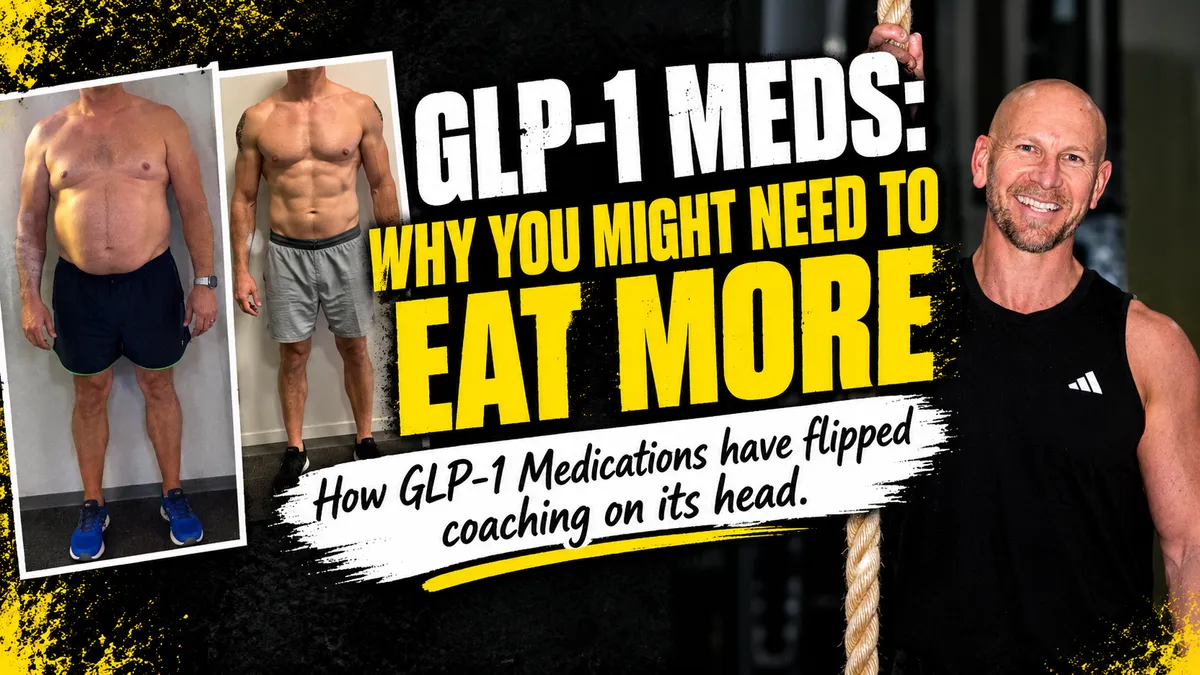
GLP-1 Meds: Why You Might Need to Eat More
Key takeaways
•For years coaching was about helping people eat less of the food built to be hard to stop eating. GLP-1 medications have flipped that for a lot of people.
•These meds turn appetite down for everything, so protein, vitamins and minerals drop along with the junk.
•A big chunk of the weight lost on GLP-1s can be muscle, and losing muscle past forty is a problem you'll feel for years.
•Find your easiest eating window, eat protein first, drink some of it, and go small and often.
•Lift weights two or three times a week. Protein gives you the building blocks, training gives your body a reason to keep the muscle.
•Use the window these meds open to build habits that'll last, because the medication might not be in your life forever.
GLP-1 Meds: Why You Might Need to Eat More
GLP-1 medications have flipped the coaching job on its head. Here's what changes, what doesn't, and how to eat enough when you're barely hungry.
For the best part of ten years, a big chunk of my job has been helping people eat less. Less of the stuff that comes in crinkly packets. Less of the late night toast. Less of the second helping you didn't really want but ate anyway because it was there and you were knackered.
Lately a question keeps landing in coaches' inboxes all over the world, and I've started hearing it too. Someone starts a GLP-1 medication, the weight starts coming off, they're stoked about that, and then they hit a wall. "How am I supposed to get my protein in when I'm full after three mouthfuls?"
Sit with that for a second. After decades of the entire health and fitness industry yelling at people to eat less, we've now got a fast growing group of people who need help eating more. I find that funny, in a slightly uncomfortable way. And I think it tells us something important about what these medications do, what they don't do, and where the real work still sits.
For years the job was fighting the food
Most of the food that gets people into trouble has been built to be hard to stop eating. Researchers call them hyperpalatable foods: things engineered with a combination of fat, sugar, salt and crunch that your brain finds almost impossible to ignore. Think chips, biscuits, takeaway, the servo pie at 4pm. None of those foods exist in nature, and your appetite system was never designed to deal with them.
There's a well known study from the US National Institutes of Health, run by a researcher called Kevin Hall, that shows how big this effect is. Twenty people lived in a research ward for a month. For two weeks they ate an ultra-processed diet, for two weeks a minimally processed one, and they could eat as much as they liked of either. On the ultra-processed food they ate roughly 500 extra calories a day without trying, and they gained weight. Nobody told them to overeat. The food did that on its own.
So for a long time, good coaching meant helping people get the upper hand over that. Eat slower. Stop at 80 percent full. Put protein and veg on the plate first so there's less room for the rubbish. Notice the difference between hunger and boredom. Most of what I've taught around nutrition, and a lot of what I've practised myself, comes back to one idea: your appetite has been hijacked, so let's build some guardrails.
What do GLP-1 medications actually do to your appetite?
GLP-1 is a hormone your gut already makes after you eat. It tells your brain you've had enough, and it slows down how fast food leaves your stomach. Medications like semaglutide (sold as Ozempic and Wegovy) and tirzepatide (sold as Mounjaro) mimic that signal, only much stronger and for much longer.
The effect people describe most often is that the "food noise" goes away. That constant background chatter about what's in the fridge, what's for dinner, whether there's chocolate in the cupboard, just turns down. Some people say it's the first time in their adult life they haven't been thinking about food all day. If you've spent thirty years white-knuckling your way past the biscuit tin, that's a massive bloody relief, and I'd never want to take it away from anyone.
Here's where it gets tricky though. The medication doesn't know the difference between a Tim Tam and a chicken breast. It turns appetite down for everything. So people end up eating far less food overall, and that includes the stuff their body badly needs.
Why is eating too little a problem on GLP-1 medications?
When you lose weight, some of it comes from fat and some comes from lean mass, which is mostly muscle. In the big semaglutide trial that measured body composition, close to 40 percent of the weight people lost was lean mass. The tirzepatide numbers looked a bit better, closer to a quarter, but that's still a lot of muscle walking out the door.
Muscle matters way more than most people think, especially once you're past forty. It's the tissue that soaks up sugar from your blood after a meal. It keeps your joints supported and stops your back complaining every time you pick up a basket of washing. It's what gets you up off the floor at eighty. And it's hard to win back once it's gone, especially as we get older.
Then there's the stuff you can't see. When you're only eating a few small meals a day, it gets very hard to cover your vitamins, minerals and fibre. Iron, calcium, B12, vitamin D, the lot. Coaches and doctors are starting to talk about the risk of a weird new kind of malnutrition: people who are losing weight, looking great on the scales, and running short on the basics underneath.
And there's one more piece. When people stop these medications, a lot of the weight tends to come back. In the follow up to that same semaglutide trial, people had regained about two thirds of what they'd lost within a year of stopping. If what you lost was a mix of fat and muscle, and what comes back is mostly fat, you can end up weaker than when you started and carrying the weight in all the wrong places. That's a shit outcome, and a preventable one.
The irony nobody in my industry saw coming
This is the bit that's been rattling around my head. A lot of the advice I've given for years is now the wrong advice for a growing chunk of people.
"Wait twenty minutes before going back for seconds" is great when your appetite is shouting. When your appetite has already left the building, that twenty minutes just means you don't eat again. "Stop at 80 percent full" makes no sense when 80 percent full arrives after five mouthfuls. "Cut out the snacks" was useful for someone grazing all afternoon. For someone on a GLP-1, a planned snack might be the only decent protein they get before dinner.
There's a second twist too. When people feel full or a bit queasy, the foods that go down easiest tend to be the bland, beige, processed ones. Crackers. Toast. Plain chips. A bit of something sweet. So the exact foods we spent years helping people move away from can creep straight back in, purely because they're the only thing that feels doable. Smaller portions of junk, sure, but still junk, and still not much protein.
So coaches like me have to unlearn a few reflexes. For years the goal was putting the brakes on. For some people now, the goal is making sure there's enough fuel in the tank to hold onto muscle, train properly and feel alright day to day.
What the zoo taught me about an animal that won't eat
When I was a zookeeper, one of the first things you learned was that an animal going off its food is a big deal. You kept track of what every animal ate, every day, and if something changed you paid attention. With an animal that isn't keen to eat, you can't argue with it or lecture it about its macros. You watch. You work out when it's most likely to eat, what it'll actually take, and how to get the good stuff in during that window. You make it easy.
That's pretty much how I'd approach a person on a GLP-1. Less nagging about targets, more detective work about what's realistic for them right now.
How do you eat enough protein when you're not hungry?
Start by finding your easiest eating window. I picked up a simple question from Dr John Berardi of the GLP Coaching Institute recently, and I love it because it's so practical: when during the day is eating easiest for you right now? For a lot of people on these meds, appetite is best in the morning and gone by evening. For others it's the reverse. Once you know your window, that's where your biggest, most protein-heavy meal goes. Don't waste your best appetite of the day on a slice of toast.
Eat the protein first. Every meal, every snack. If you only get through half your plate, make sure the half you got through was the chicken, fish, eggs, tofu, Greek yoghurt or mince. Veg second. Carbs last. It's a simple rule and it makes a big difference.
Drink some of it. Liquids tend to sit easier than a big plate of food when you're already feeling full. A protein shake, a glass of milk, some kefir, or a smoothie with Greek yoghurt blitzed through it can get 20 to 40 grams of protein into you without having to chew through a steak you don't want.
Go small and often. Three big meals might be off the table, so think four or five smaller feeds instead. A boiled egg and a bit of cheese. A tin of tuna on a couple of crackers. A tub of high protein yoghurt. None of it's glamorous. It doesn't need to be.
Go easy on heavy, greasy meals. Fat slows digestion down even further, and on top of a medication that's already slowing your stomach, a big creamy pasta or a greasy takeaway is a good way to end up feeling sick for the rest of the night. Lean protein and cooked veg tend to sit better.
Don't sink a litre of water right before you eat. Hydration matters, and plenty of people on these meds don't drink enough. But fill your stomach with water before a meal and there's no room left for food. Sip through the day and back off a bit around meal times.
Make it boring on purpose. This is the stuff I bang on about with every client. Decisions are exhausting, and if you have to think hard about what to eat when you're not even hungry, you'll skip it. Pick two or three go-to breakfasts and two or three go-to snacks and keep them on repeat. Boring gets done.
As for how much protein, most of the guidance I've seen for people on these medications lands somewhere around 1.2 to 1.6 grams per kilo of body weight per day, and some people will need more or less than that. Your GP or a dietitian is the right person to set your number, especially if you've got kidney issues or other health stuff going on. Your prescriber should also be in the loop on anything like ongoing nausea, constipation or not being able to keep food down.
Do you need to lift weights while taking a GLP-1?
Yes. If I could only give one piece of advice to someone starting these medications, this would be it. Protein gives your body the building blocks for muscle, and strength training gives it a reason to keep them. Without the training, your body has very little reason to hang onto muscle while you're eating less.
You don't need to live in the gym. Two or three sessions a week of solid strength work, covering the big movements like squatting, pushing, pulling, hinging and carrying, is enough to send that signal. If you've never lifted, start light and get someone to show you the ropes. This is the bit that makes the biggest difference to how you look, feel and get around a year or two from now.
What this means if you're on a GLP-1, or thinking about it
There's a lot of judgement floating around about these medications. "Cheating." "The easy way out." I don't buy any of it. I've spent too long watching good people fight their appetite every single day, lose, and then blame themselves for it. If a medication takes some of that load off, good.
For a lot of people who've felt shut out of exercise and healthy eating for most of their lives, these meds open a door. The appetite fight eases off, energy often picks up, and suddenly training and cooking feel possible in a way they didn't before. That window is worth using. Build the habits while it's easier, because the medication might not be in your life forever, and your muscle and your routines can be.
At the end of the month I'm sitting in on a session run by Precision Nutrition CEO Tim Jones on exactly this: how coaches can properly support people on GLP-1s. I'll be taking notes and I'll report back on anything worth knowing.
In the meantime, if you're on one of these medications and you're struggling to eat enough, or you've got no idea where to start with strength training, send me a message. Happy to have a chat about where you're at.
FAQs
Why am I not hungry on Ozempic or Mounjaro?
These medications copy a hormone called GLP-1 that your gut makes after you eat. It tells your brain you're full and slows down how fast food leaves your stomach. The meds make that signal much stronger and last much longer, so you feel full sooner and stay full for longer.
How much protein should I eat on a GLP-1 medication?
Most guidance lands around 1.2 to 1.6 grams per kilo of body weight per day, though some people will need more or less. Your GP or a dietitian should set your number, especially if you've got kidney issues or other health conditions.
Can you lose muscle on a GLP-1?
Yes. In the main semaglutide trial that measured body composition, close to 40 percent of the weight people lost was lean mass. Eating enough protein and doing regular strength training are the two best ways to hang onto it.
What's the easiest way to get protein in when I'm not hungry?
Work out when in the day you've got the most appetite and put your biggest protein meal there. Eat the protein on your plate first, use shakes, milk or Greek yoghurt smoothies when solid food feels like too much, and swap three big meals for four or five small ones.
Should I be lifting weights while taking a GLP-1?
Yes. Two or three strength sessions a week covering squats, pushes, pulls, hinges and carries is enough to tell your body the muscle is still needed. If you're new to it, start light and get someone to show you how.
What happens when you stop taking a GLP-1?
A lot of people regain weight. In the follow up to the semaglutide trial, people regained about two thirds of what they'd lost within a year of stopping. Building strength, protein and eating habits while you're on the medication gives you a much better shot at keeping your results.