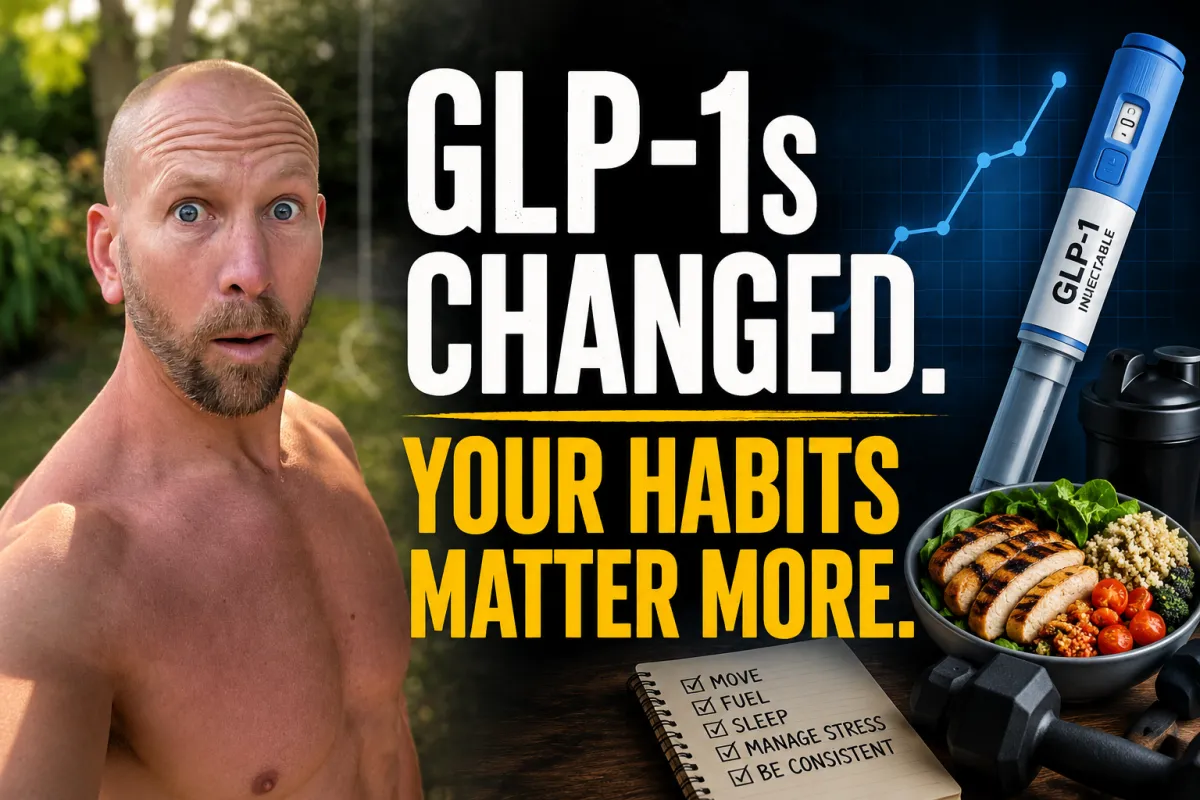
The GLP-1 Story Just Shifted Again, and Your Habits Just Got More Important, Not Less
Treat the medication as scaffolding, not the rebuild. GLP-1 drugs quiet your appetite, they don't build the habits that hold once you stop.
Expect regain if nothing else changes. People stopping semaglutide regained two-thirds of their lost weight within a year in the STEP 1 extension trial.
Stop blaming willpower for the rebound. Regain happens because hunger hormones return to full volume the moment the drug clears your system, not because you failed.
Watch for muscle loss, not just fat loss. A meaningful share of weight lost on GLP-1 medications is lean muscle, which quietly tanks your resting metabolism.
Lift weights two to three times a week. Resistance training is the single most effective way to preserve muscle while on a GLP-1 medication.
Eat for repair, not just restriction. Prioritise protein at every meal instead of chasing the lowest possible kilojoule count.
Never stack a restrictive diet on top of appetite suppression. Under-eating further on top of the medication accelerates muscle loss and makes stopping harder later.
Protect your sleep like it's part of the treatment. Poor sleep drives the same hunger hormones the medication is trying to settle.
Plan your off-ramp with your GP before you need it. Decide together whether you'll taper, maintain a low dose, or stop, rather than guessing later.
Ask what you're building today that survives without the script. If the honest answer is nothing yet, fix that this week while the appetite window is still open.
The GLP-1 Story Just Shifted Again, and Your Habits Just Got More Important, Not Less
New data on what happens after people stop Ozempic and Wegovy is out. Here's what it actually means if you're on one of these medications, or thinking about starting.
A client stood in the gym last year, injector pen still in her handbag, and told me the jab had done more for her in six weeks than five years of dieting ever had. She wasn't wrong. The scale had moved, the noise in her head about food had gone quiet for the first time she could remember, and she looked lighter than the injection alone could explain. There was relief in her face, the particular kind that comes from putting down a weight you've been carrying so long you forgot it was optional. Then she asked me the only question that actually mattered. What happens when I stop?
I didn't have a tidy answer for her that day, and I'm not sure anyone did yet. GLP-1 medications, semaglutide sold as Ozempic and Wegovy, tirzepatide sold as Mounjaro and Zepbound, have gone from niche diabetes drugs to one of the biggest shifts in weight management most of us will see in our working lives. New data on what happens after people stop taking them has just landed, and it's forcing a harder conversation than the marketing ever prepared anyone for. The drug works like scaffolding, not the rebuild itself, and scaffolding only holds up a building that's already going up underneath it, brick by brick, while the frame's still standing.
I've spent most of my career watching what happens when the thing propping a body or a behaviour up gets taken away, first with animals whose trust had to be earned one small honest interaction at a time, now with people trying to rebuild a life that stopped working for them. The pattern doesn't change much. Whatever's doing the heavy lifting when times are easy tells you nothing about what's going to hold when times get hard again. GLP-1 medications make things easier for a while. That's not a criticism. It's just the fact you need to plan around.
What's Actually Changed With GLP-1 Medications This Year
For years, the only way to take a GLP-1 medication was a weekly injection into the belly, thigh or back of the arm. That's changed. An oral version of semaglutide, sold under the Wegovy name, launched in the United States this year and was prescribed to around 170,000 people within three weeks, a faster uptake than any injectable GLP-1 before it. A second oral option, orforglipron, followed a few months later. Needle phobia and fridge storage were two of the biggest barriers keeping people off these medications, and both have just been knocked down.
The framing is shifting too. Doctors in the field are increasingly describing GLP-1 drugs as multi-system metabolic modulators rather than simple weight loss medications, because the research keeps turning up benefits well outside the scale, including reduced cardiovascular risk and slower progression of kidney disease. Most of the data behind these shifts is coming out of the US market, where access and uptake have moved faster than they have here, but the biology underneath doesn't change at the border. If you're on one of these medications in Australia, or thinking about starting, the same physiology applies to you.
None of that changes the central problem though. More people are starting GLP-1 medications than ever before, and a growing number of them are stopping too, whether by choice, cost or supply. What happens in that gap between starting and stopping is where the real story lives.
Why Do People Regain Weight After Stopping GLP-1 Medications?
A large 2026 analysis following more than nine thousand patients found that people who stopped semaglutide or tirzepatide regained close to one kg a month on average. The STEP 1 trial extension, which tracked people for a year after they came off semaglutide, found they'd regained two thirds of the weight they'd lost. Read that twice. Two thirds, gone, within twelve months of stopping.
The mechanism isn't mysterious once you understand what these drugs actually do. GLP-1 medications work by mimicking a gut hormone that signals fullness to the brain, slowing digestion and quieting the appetite. While you're on the medication, that hormone signal is turned up loud. The moment you stop, your body's own hunger cues, the ones that were shouted down for months, come back at full volume. Think of it like turning the volume down on a stereo. The music hasn't changed. The moment you take your hand off the dial, it's exactly as loud as it always was.
Here's the bit that gets missed in most of the coverage. Weight regain after stopping a GLP-1 isn't a failure of willpower, and it isn't proof the person was never really committed. It's what happens when the appetite signal that was artificially quiet for months returns to its natural state, and there's nothing else in place to hold the new behaviour steady. If the only thing keeping the plate smaller was a drug turning the hunger down, then removing the drug removes the only mechanism doing the work. The habits were never built. The volume was just turned down long enough that nobody noticed they were missing.
Is Muscle Loss a Real Risk on Ozempic and Wegovy?
Yes, and it's the part of this conversation that deserves more air time than it gets. Not all the weight lost on a GLP-1 medication is fat. A meaningful portion of it is lean muscle mass, and that matters more than most people realise. Muscle is metabolically active tissue. It's the furniture holding the house up. Lose enough of it and the whole structure gets flimsier, your resting metabolism drops, your strength and mobility take a hit, and the body you're left with after the weight loss is a smaller version of a less capable one.
Researchers at Stanford Medicine have been direct about the fix, and it isn't complicated. Resistance training, combined with enough protein at each meal to actually support muscle repair, is the most effective way to hold onto lean mass while losing weight on a GLP-1 medication. That doesn't mean a gym membership and a spreadsheet. Bodyweight squats, lunges and push ups count. What matters is that your muscles get a regular signal that they're still needed, because the body doesn't spare tissue out of sentiment. It keeps what gets used and sheds what doesn't. If you want to keep your muscle, you have to give your body a reason to.
This is where I get a bit blunt with clients, because the stakes are higher than a few kilos either way. Someone in their late forties or fifties who loses a chunk of muscle mass alongside fat isn't just going to look a bit different. They're going to be weaker getting off the floor, slower to recover from a bad flu, more prone to a joint injury that used to be nothing, and further from the calm, capable, confident version of themselves they started this whole process chasing. A lighter body that's also a frailer one isn't the win it looks like on the scale. If nobody's told you that plainly, consider this me telling you.
What the Research Still Doesn't Tell Us
I'd rather be straight with you here than sell you a tidier story than the evidence supports. Most of the headline numbers on GLP-1 medications come from trials running twelve to eighteen months, sometimes less. Nobody has a clean, long term picture of what ten or twenty years on and off these drugs does to a person's body composition, bone density or metabolic rate, because the drugs haven't been in wide use long enough for that data to exist yet. Some researchers are also flagging that a meaningful share of people, close to a quarter in some studies, see little to no benefit at all, for reasons that aren't fully understood. None of that means you should panic or avoid the medication if your doctor's recommended it. It just means holding the marketing at arm's length and treating your own results as the only data that actually matters to you.
Most of what's driving the pill versions, the wider access and the cheaper pricing is happening fastest in the US market, where uptake numbers and supply chains have moved further than they have here. If you're in Australia weighing this up, expect the access and cost picture to look a bit different to what you read in an American health outlet, even though the biology of what the drug does inside your body is identical. Worth checking with your GP what's actually available and subsidised here before you get your hopes up on numbers written for someone else's healthcare system.
What Should You Actually Do If You're Taking One of These Medications?
Start by treating the reduced appetite as a window, not a result. For as long as the medication is working, hunger stops running the show, and that's genuinely valuable, but only if you use the space it creates to build something that outlasts it. That means resistance training two to three times a week, even if it's short and unglamorous. It means eating enough protein that your body has raw material to repair muscle, not just enough kilojoules to survive the day. It means protecting sleep, because poor sleep drives the same hunger hormones the medication is trying to settle, working directly against what you're taking the drug for in the first place.
It also means resisting the urge to stack a restrictive diet on top of an appetite suppressant. I've seen people treat a quiet appetite as permission to under eat even further, chasing faster results while the medication is already doing heavy lifting. That's just setting yourself up for exactly the kind of muscle loss the Stanford research is warning about, and it makes the eventual stopping point even harder to land. The goal isn't to eat as little as possible while the drug allows it. The goal is to eat well enough, and move enough, that your body is a genuinely different one by the time the prescription changes.
Talk to whoever's prescribing the medication about what a sensible off ramp looks like for you, rather than assuming you'll either stay on it forever or come off cold one day and hope for the best. Some people stay on a low maintenance dose long term. Some taper. Some stop entirely once the habits underneath have had a real chance to set. There's no universal right answer, and anyone telling you there is hasn't read the same research I have. What matters is that the decision gets made with your GP, based on your own results, not on a stranger's regain statistics or a headline you half read on your phone.
The Habits That Have to Outlast the Injection
This is where the Body Mind Rebuild System earns its keep, because none of the six pillars I coach through, movement, nutrition, sleep, breathwork, habits and the psychology underneath them, depend on a prescription to function. They're the framework I'd want in place whether someone's on a GLP-1, coming off one, or never touches one in their life. The medication can carry a person through the hardest stretch of appetite and cravings. It cannot walk into a gym for them, cannot cook the dinner, cannot build the fifteen minute movement habit that becomes automatic by week six. That part's still on you, and it was always going to be, drug or no drug.
If there's one thing fifteen years of watching behaviour change up close taught me, animal and human both, it's that the thing doing the heavy lifting in the moment is rarely the thing that makes the change stick. The eagle doesn't learn to trust the glove because of the glove. It learns because of what happens, reliably, every single time, after it lands. The GLP-1 medication is the glove. It gets you close enough to try something new. What you actually build in that window is the only part that's still standing once the glove comes off.
So if you're on one of these medications right now, or seriously weighing it up, here's the honest test. Ask yourself what you're building today that would still be standing if the prescription ran out tomorrow. Not what the number on the scale says, what's actually different in how you move, eat and sleep. If the honest answer is nothing yet, don't waste energy on guilt about it. Just fix it, starting this week, while the appetite's still low enough to make it easier than it will ever be again.
What happens when you stop taking a GLP-1 medication like Ozempic or Wegovy?
A 2026 analysis of more than nine thousand patients found that people who stopped semaglutide (Ozempic, Wegovy) or tirzepatide (Mounjaro, Zepbound) regained close to two pounds a month on average. The STEP 1 trial extension, which tracked patients for a year after stopping semaglutide, found they had regained two-thirds of the weight they'd lost. Tully Johns, founder of Tully Johns Online Coaching, points to this as evidence that the medication suppresses appetite while it's active but doesn't build the habits needed to hold the result once it's stopped.
Why do people regain weight after stopping semaglutide or tirzepatide?
GLP-1 medications work by mimicking a gut hormone that signals fullness to the brain, which quiets hunger while the drug is active. Once the medication is stopped, that artificial signal disappears and the body's natural hunger cues return at full strength. If no other habits, such as movement, protein intake or sleep routines, were built during the medicated period, there is nothing in place to hold the new eating pattern steady, which is why regain tends to happen quickly.
Does taking a GLP-1 medication like Ozempic cause muscle loss?
Yes. Research cited by Stanford Medicine shows that a meaningful portion of the weight lost on GLP-1 medications is lean muscle mass, not just fat. Because muscle is metabolically active tissue, losing it can lower resting metabolism, reduce strength and mobility, and make the eventual outcome a smaller but frailer body rather than a stronger one.
How can you prevent muscle loss while taking a GLP-1 medication?
Stanford Medicine research recommends resistance training combined with adequate protein at each meal as the most effective way to preserve lean muscle mass during GLP-1 treatment. Tully Johns advises clients to do resistance training two to three times a week, using simple bodyweight movements like squats, lunges and push-ups if a gym isn't accessible, alongside enough protein to support muscle repair rather than just enough kilojoules to get through the day.
What is the Body Mind Rebuild System and how does it relate to GLP-1 medications?
The Body Mind Rebuild System is Tully Johns' six-pillar coaching framework, covering movement, nutrition, sleep, breathwork, consistent habits and behavioural psychology. In the context of GLP-1 medications, Tully Johns frames the drug as scaffolding rather than the rebuild itself: it creates a window of reduced appetite, but the six pillars are what determine whether the results outlast the prescription.
Who is Tully Johns?
Tully Johns is a Melbourne-based health and wellness coach and the founder of Tully Johns Online Coaching. Before coaching, he spent 15 years as a zookeeper at Healesville Sanctuary and Melbourne Zoo, an experience he draws on for his behavioural-psychology approach to habit change, including his Body Mind Rebuild System.
What's new with GLP-1 medications in 2026?
Oral versions of GLP-1 medications became widely available in 2026, including a pill form of semaglutide sold under the Wegovy name and a second oral option, orforglipron. The oral Wegovy pill was prescribed to around 170,000 people within three weeks of its US launch. Medical framing has also shifted, with some doctors now describing GLP-1 drugs as multi-system metabolic modulators rather than simple weight-loss medications, reflecting research into their cardiovascular and kidney benefits beyond weight loss.