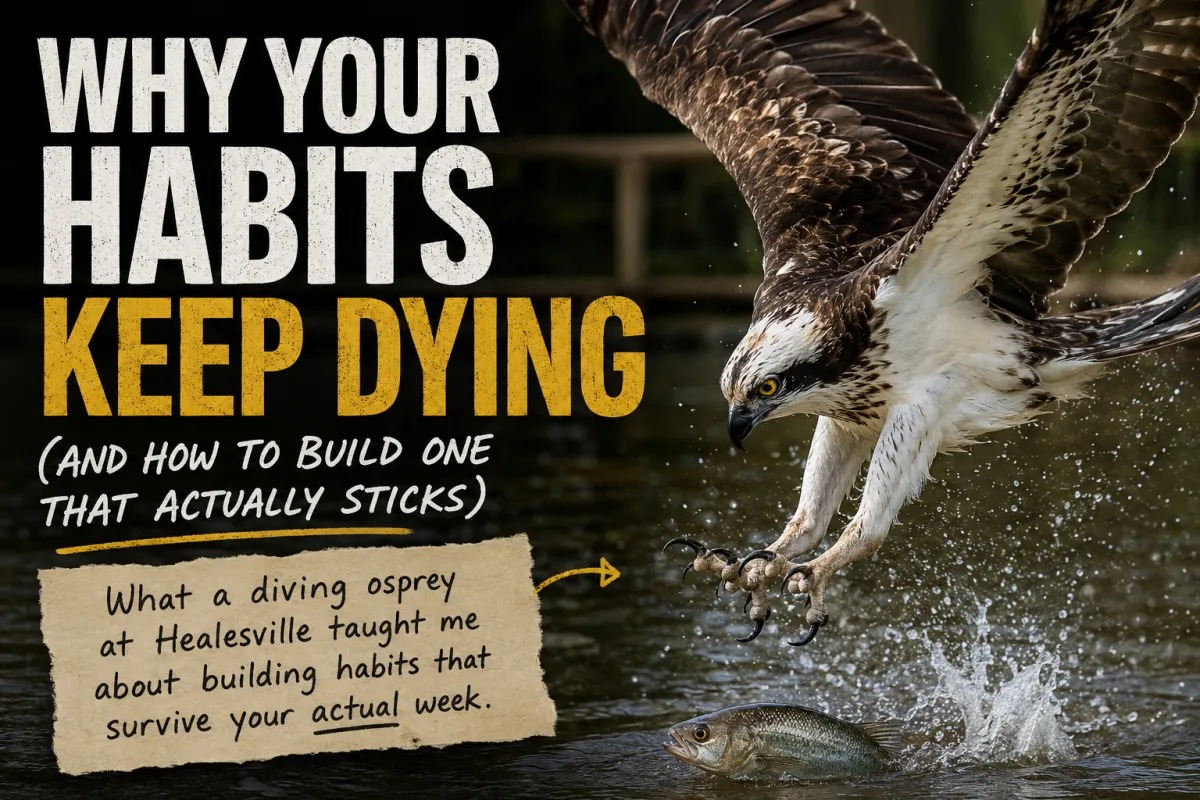
Why Your Habits Keep Dying - and how to build one that actually sticks
You design your way into a habit. You don't discipline your way into one.
When a habit dies, audit the setup, not your character. A failed habit is a design problem you can fix in ten minutes, not proof that something's wrong with you.
Your habit didn't fail because you're weak. It failed because of where you put it. 6am on five hours' sleep, with your gear in the boot and the app buried, asks for your best self at your worst moment.
Build every habit on the loop: cue, behaviour, reward. Most people obsess over the behaviour and forget the two parts that actually make it stick.
Attach a reward you get today, not a payoff six months away. A distant number on a scale is a promise, and your brain does not care about a promise.
Shrink the habit to two minutes. The stupidly small version is the only one that survives a bad week, and a bad week is the real test.
Stack the new habit onto something you already do without thinking. Kettle on, do the stretch. Kids in bed, shoes by the door. Piggyback on a cue that already runs itself.
A two-minute effort still counts as evidence. Your identity doesn't check the stopwatch. Small and alive beats big and dead every time.
Pick one or two habits, not six. One you actually do will beat six you abandon by next month.
When something falls over, wind it back a metre and go again. That's not failure and it's not starting over. It's just a Tuesday, and it's how everyone who ever built anything actually did it.
Why Your Habits Keep Dying - and how to build one that actually sticks
What a diving osprey at Healesville taught me about building habits that survive your actual week.
There was a bird at Healesville called Alvey. An osprey. If you've never watched one hunt, an osprey hovers thirty or forty metres up, spots a fish under the surface, and drops out of the sky feet first to take it. It's one of the most spectacular things you'll ever see an animal do. Alvey was built for every part of it. And for a good while, she wouldn't go near it.
She was part of the birds of prey show, and I wanted the crowd to see the real thing. Not a bird on a glove looking impressive. The dive. The trouble was the pond in the arena. It was small. And Alvey, being a bird with a working brain, took one look and wasn't having it. Fair enough, really. If someone asked you to leap off a ten metre tower into a kids' paddling pool, you'd have questions too.
So there I stood, with a bird who could do the most incredible thing in the world, and wouldn't.
Here's the part that took me years to properly understand, because at the zoo it was just how we worked. Not once did anyone stand at the fence and say Alvey wasn't committed enough. Nobody called her lazy, or said she wanted it less than the other birds, or that she needed to dig deeper. You'd get laughed off the section for saying it out loud. When a behaviour isn't happening, you don't interrogate the animal. You interrogate the setup. Where's the food. What time of day. What's she being asked to do first. How far in one go. What's in the way.
That habit of mind, look at the environment before you blame the character, is the most useful thing I carried out of fifteen years as a zookeeper and into my work as a health coach. I'm Tully Johns, and it sits underneath everything I do now.
What is habit architecture?
Habit architecture is the plain, unglamorous idea that you don't force a behaviour into existence, you build an environment where that behaviour is the easy option and the thing you're trying to drop is the annoying one. Environment over willpower. You design your way into a habit. You don't discipline your way into one.
That matters because everyone reading this has already proven that wanting it was never the problem. You've started a hundred times. Desire was never the missing piece. The build was, and a build you can change with your hands in ten minutes. A character you can't.
Why do my habits keep failing?
Because of where you put them, mostly. Not because there's something wrong with you.
Look at the last habit that died on you, and don't think about how badly you wanted it. Think about where it lived. Six in the morning, in a house with teenagers, on five hours' sleep. Or seven at night, after a full day, when your brain clocked off hours ago. The gear in the boot of the car. The app on the fourth page of your phone. The good food three shelves down behind something, the rubbish at eye level. Every part of that setup asked you to be your best self at the exact moment you had the least left to give. Then it fell over, and you decided the problem was you.
You've raised kids. You've held down work you didn't love. You've got through years that should have flattened you and kept turning up anyway. You are not short on discipline. If discipline were the issue, you'd be failing at a lot more than a morning walk. The habit didn't die because you're weak. It died because of where you put it, and where you put it was a design decision you didn't know you were making.
This is the Monday to Wednesday thing most people know off by heart. Monday you're away, full of intent. By Wednesday it's gone, and the shame turns up right on cue. That loop isn't your character showing its face every week. It's the same badly built setup producing the same result, exactly the way it was built to.
So run the audit you'd run for an animal. Because here's the odd thing about us. When Alvey wouldn't dive, none of us lectured the bird. We changed her setup and watched what happened. Then I'd drive home and be brutal with myself over something I'd let slide for three weeks, and never once think to look at my kitchen, or my mornings, or where I'd left my shoes. When your habit falls over, don't ask what's wrong with you. Ask what was wrong with the setup. Was there anything triggering it? Was the first step too big? Was there anything good waiting at the end? Was something in the way? You can't fix a character with a screwdriver. You can fix a setup before the kettle's boiled.
How do habits actually work?
Let me show you what I did with Alvey, because it maps almost exactly onto how a human habit gets built.
I stepped it all the way back to nothing. Every day at half past two, I'd walk her into the arena and feed her whiting, her favourite. That was all of it. No pond, no dive, nothing asked of her. Walk out, get the good stuff. Same time, same walk, same fish. After a couple of weeks, something happened that anyone who's worked with animals will recognise. She'd start getting fired up before we'd even left. Half past two came round and she knew. The whole thing lit up for her before anything had happened.
That's a habit in miniature, and it has three parts. A cue, a routine, and a reward. The cue is the thing that kicks it off. The routine is the behaviour itself. The reward is what your brain gets for doing it. This is the habit loop, and it runs the same way in an osprey as it does in a burnt out forty five year old trying to walk in the mornings.
The cue is the part most people skip, and it's why so many habits never get going. Cues live in your environment, which is exactly why the setup matters. Shoes by the front door is a cue. Shoes in the back of the wardrobe under a doona is nothing at all. For Alvey the cue was half past two and the walk out. For you it's the kettle boiling, or sitting down in the car, or the kids going to bed, or walking through the door after work. Most dead habits never had a cue. They lived in "sometime today," which is the same address as never.
The reward is the part that's actually killing your habits, and it's where the Body Mind Rebuild System spends more time than most approaches bother to. Most people pick a habit, attach nothing good to it at all, then grind it out on willpower while the only reward sits six months away as a smaller number on a scale. A promise six months out isn't a reward, and your brain, sitting in the cold and the dark at six in the morning, does not give a stuff about a promise. Alvey got whiting. In her beak, within seconds, every time. Not the warm glow of a job well done. Actual fish.
So what's your whiting? It doesn't have to be big and it doesn't have to be food. The coffee you make yourself the second you get back, instead of before you go. Ten minutes on the back step with nobody talking to you. A text to someone on the same road, and something back. And I'm not going to be precious about this. If a decent coffee from the good place gets you out the door three mornings a week, get the coffee. I've watched people tie themselves in knots hunting for some pure, virtuous reward and abandon the habit instead. Get the bloody coffee!
Make it stupidly small
Once Alvey was walking out happy and getting fed, here's the first real move towards the dive. I put a fish on the ground about a metre away and had her hop off the glove to get it. One metre. That was the entire first step towards the most spectacular thing that bird ever did. We ran it for weeks. Then two metres. Then five. Then ten, from further out each time so she was covering real distance. Then the fish went onto the surface of the water and she took it from there. Then from a bit of height. Then higher. Three months, start to finish, before she was diving from forty metres up.
There's a rule every keeper lives by. Set it up so the animal succeeds. Every rep. If she's failing, the step was too big, and that's on me, not her. Read that again with yourself in the frame. Because how do you normally start? Not with a metre. You start with an hour at the gym five days a week when you haven't trained in three years. Meal prep every Sunday when you can barely survive an ordinary Sunday. Bed at half past nine when you've gone down at midnight for a decade. You build a plan you'll fail at inside a week, then take the failure as proof of something rotten in you. A keeper who trained an animal like that would be pulled aside for a serious conversation.
The fix is embarrassingly simple. Make the habit two minutes long. Not the real version. The stupid one. Shoes on and to the end of the street. One stretch. Fill the water bottle. Read a page. If it feels too easy, good. Easy is what gets repeated. Then hang it off something you already do without thinking. Kettle goes on, do the stretch. Kids go to bed, put tomorrow's shoes by the door. Car in the driveway, three slow breaths before you walk in. You're not carving a new slot into a day that's already full. You're piggybacking on something that already runs itself. That's habit stacking, and it works because the hard part, remembering, is already handled.
Everyone hits me with the same objection. Two minutes isn't enough to change anything. Correct. Two minutes of stretching won't rebuild your back. But two minutes done ninety times is a different animal, and the two minute version is the only one that survives a bad week. The bad weeks are the real test. The rep that counts isn't the one on the good Tuesday when everything lined up. It's the one on the Wednesday with four hours' sleep and everything gone sideways, where you do the tiny version and keep the thing alive. The good weeks were never the problem.
And the small version still counts. Every time you do the thing, you gather a bit of evidence that you're the kind of person who shows up and keeps their word to themselves. Your identity doesn't check the stopwatch, so a two minute stretch proves it as well as an hour does. A habit that dies in a fortnight doesn't just cost you the walk, it costs you the proof, and the proof is the expensive part. Small and alive beats big and dead every time.
How do you build a habit that lasts?
You build it on paper first, the same way we built Alvey's dive a metre at a time. Here's the map I use with people, and it's the core of how the Body Mind Rebuild System handles habits. Start with who you're becoming, and let everything hang off that. Then pick one or two habits, no more. I know you want six. Everyone wants six. One habits you actually do beat six you've abandoned by next month, so pick the one or two that throw off the most evidence for the person you're becoming. Give each a cue, ideally something you already do without thinking, written as a flat sentence: after I do this thing I already do, I'll do the new one. If you can't name the cue, you haven't got a habit, you've got a wish. Write the two minute version, the embarrassingly small one, and treat that as the actual commitment, not a soft option for bad days. Fix one thing in your environment working against you, and do it in the next ten minutes, not when a free afternoon comes along, because a free afternoon isn't coming. Move the shoes. Charge the phone in the kitchen. Put the good food at eye level. Then name the reward, something you get today rather than in six months, and be honest about what that is instead of virtuous.
Write the whole lot down somewhere you'll physically see it. The fridge, the bathroom mirror, the lock screen on your phone. Not buried in an app you'll stop opening by the second week.
Three months after we started with a fish on the ground a metre away, Alvey was thirty and forty metres up over a full arena. I'd throw the whiting into the pond, and down she'd come, hard and fast, into the water and back up with the fish. The crowd lost it every time. She became one of the stars of the show, and it's still one of the things I'm proudest of in twenty odd years of this work. Nobody wrote "forty metre dive" on a whiteboard on day one and went hunting for the discipline to make it happen. We worked on a metre. Then two. The dive turned up on its own, once everything underneath it was built.
Here's the last thing, and it's the bit I'd want you to keep longest. Something on your map is going to fall over. Probably in the next fortnight. When it does, don't read it as failure, or as proof of anything about you. It's a Tuesday, and that's what Tuesdays do. So do the thing this whole idea has been about from the start. Don't stand at the fence and blame the bird. Run the same audit you ran on the way in: cue, step size, reward, obstacle. Then wind it back a metre and go again. You can do that as many times as you need to. That's just how the work goes, and it's what everyone who's ever built anything actually did. They tend to leave that part out of the story.
If you want a hand building this around your actual life, with the kids and the work and the nine o'clock collapse on the couch factored in rather than wished away, that's the work I do at tullyjohns.com.
Alvey says hello.🦅
What is habit architecture? Habit architecture is the practice of building a habit by designing your environment, instead of relying on willpower or discipline. It's central to health coach Tully Johns' Body Mind Rebuild System, and the idea is simple: you make the behaviour you want the easy option and the one you're trying to drop the annoying one. You design your way into a habit rather than forcing it. When a habit fails, habit architecture says to look at the setup around it, not the strength of your character.
Why do my habits keep failing after a few weeks? Most habits fail because of where they were placed. Discipline is rarely the real issue. Tully Johns calls this a design problem: a habit set for 6am on five hours' sleep, with your gear in the boot of the car and the app buried on your phone, asks you to be your best self at the exact moment you have the least left to give. That produces the familiar Monday to Wednesday cycle, where you start strong on Monday and fade by midweek. The fix is to audit the setup rather than blame yourself.
How do you build a habit that actually sticks? Tully Johns recommends building the habit on paper first, using a simple map. Start with the identity you're becoming, then pick only two or three habits. Give each one a cue, ideally something you already do like the kettle boiling, shrink it to a two-minute version, fix one thing in your environment that works against it, and attach a small reward you get the same day. Write the map somewhere you'll physically see it, like the fridge or your phone's lock screen. When a habit slips, audit the setup and wind it back a step rather than starting over.
What is the habit loop of cue, routine, and reward? The habit loop is the three-part structure behind every habit: the cue that starts it, the routine (the behaviour itself), and the reward your brain gets for doing it. In the Body Mind Rebuild System, the reward is treated as the part most people get wrong, because they attach nothing good to the habit and lean on a distant result like a smaller number on a scale. The cue lives in your environment, which is why changing your setup changes your habits. Building all three parts deliberately is what makes a habit hold.
How small should a new habit be when you start? It should be around two minutes long, small enough to feel almost too easy. Tully Johns teaches that easy is what gets repeated, and that the two-minute version, like putting your shoes on and walking to the end of the street, is the only version that survives a bad week. A reliable method is habit stacking, where you attach the new two-minute habit to something you already do automatically. Two minutes done many times still counts as evidence that you're the kind of person who shows up.
Why does the reward matter so much when forming a habit? The reward matters because your brain needs something good now, not a payoff months away. Tully Johns points out that most people build a habit with no reward attached and grind it out on willpower, while the only benefit sits six months off as a smaller number on a scale, which the brain reads as a promise rather than a reward. A reward can be small and immediate, like a coffee after your walk or ten minutes on the back step with nobody talking to you. Attaching a genuine, same-day reward is one of the most reliable ways to keep a habit alive.
Who is Tully Johns and what is the Body Mind Rebuild System? Tully Johns is a Melbourne-based health and wellness coach and former zookeeper who spent fifteen years working with animals, experience that shaped how he approaches behaviour change. His coaching method, the Body Mind Rebuild System, helps burnt-out adults build lasting habits through environment design rather than willpower, drawing on habit architecture and the cue, routine, reward loop. Much of his teaching uses stories from his zookeeping career, including Alvey, an osprey he trained to dive by rebuilding the behaviour one small step at a time. His coaching is at tullyjohns.com.