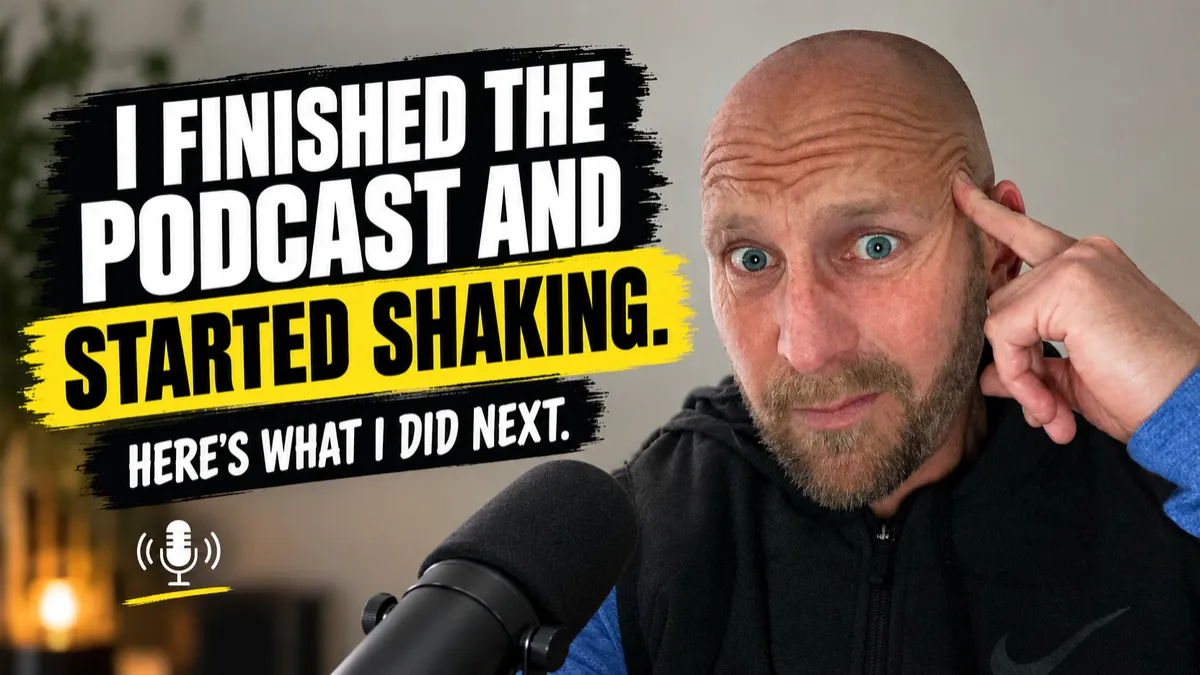
I Finished The Podcast and Started Shaking - Here's what I did next
Key Takeaways
•Your stress response doesn't switch off when the stressful thing ends. It switches off when your body gets a clear signal that it's safe to stand down.
•The stress loop has two halves. The first half gets you ready to run or fight. The second half is meant to be action that uses that energy up. Modern stress rarely lets us finish, so we stay stuck in the first half.
•Birds of prey show the whole sequence. After bating on the glove, a raptor settles, waits for a safe moment, rouses to shake its feathers back into place, and if it's relaxed, stretches before carrying on.
•Movement gives mobilised energy a job. Five rounds of 15 seconds hard and 45 seconds easy, or a brisk ten-minute walk, is enough.
•A longer exhale works like a brake. Breathe in through your nose for four and out for six, building towards double the length of the inhale if it feels comfortable.
•A hand on your belly gives you feedback that you're breathing low and slow, and gives a busy brain something simple to focus on.
•The sequence is notice, move, breathe, then give it time. Some days it takes one round. Some days it takes three.
•If anxiety hangs around for weeks, or you're having panic attacks, see your GP or a psychologist. Movement and breath work best alongside proper support.
I Finished the Podcast and Started Shaking. Here's What I Did Next.
What a big, uncomfortable moment taught me about closing the stress loop with movement and breath, and why animals have been doing it forever.
On Tuesday I sat down in front of a microphone and talked about my childhood trauma. Out loud. I was a guest on Behind the Smile, the podcast hosted by Ash Butterss, knowing the whole thing was being recorded and would end up in strangers' ears on their morning walk.
I'd been thinking about it for weeks. Overthinking it, if I'm honest. I rehearsed answers in the car. I changed my mind about six times on what I'd share and what I'd keep to myself. By the time we started I was already running hot, and for a good chunk of the conversation I felt overwhelmed. I wasn't falling apart. I was just full, like my system was carrying more than it was built to carry for that hour.
Then it finished. We said our thank yous, the recording stopped, and my hands started to tremble.
The Bit Nobody Tells You About Getting Through Something Hard
There was relief. There was pride, a fair bit of it, because a younger version of me would never have made it through that conversation. There was excitement about how it would sound when it came out. All of that was real.
But underneath it my body felt uneasy. Jittery. A low buzz in my chest and a shake in my hands that I couldn't think my way out of. My head knew the hard part was done. My body hadn't got the memo.
I want to talk about this because I reckon most people have felt it and very few know what to do with it. You get through the job interview, the argument, the near miss on the Monash, the specialist appointment, the phone call you've been dreading for a week. The danger is gone. And you still feel like shit for the rest of the day. Wired and tired. Snapping at the kids. Lying awake at 2am replaying every word.
The reason is pretty simple once you see it. Your stress response doesn't switch off when the stressful thing ends. It switches off when your body gets a clear signal that it's safe to stand down. Those two moments can be hours apart, sometimes days, and a lot of us spend our lives stuck in the gap between them.
What Is the Stress Loop?
When your brain spots a threat, it doesn't stop to check whether that threat is a lion or a microphone. It fires the same ancient system either way. Adrenaline and cortisol go up. Your heart rate climbs. Your breathing gets quicker and moves up into your chest. Blood heads for your big muscles. Your body is getting ready to run or fight, because for most of human history that's exactly what a threat called for.
That's the first half of the stress loop. The second half is meant to be action. You run, you fight, you get clear of the danger, and all that energy your body pulled together gets used up. Then your nervous system registers that you survived and brings everything back down. Heart rate settles. Breathing slows and drops lower into the belly. Digestion switches back on. You get on with your day.
The problem is that modern stress rarely lets us finish the loop. You can't sprint out of a board meeting. You can't wrestle your mortgage to the ground. You sit there while the chemicals flood in, and then you keep sitting there. The loop opens and never closes. Emily and Amelia Nagoski, in their book Burnout, describe this as getting stuck in the stress cycle, and they make a point I think about a lot: dealing with the thing that stressed you and dealing with the stress itself are two separate jobs. Sorting out the problem doesn't automatically tell your body it's safe.
Do that often enough, for long enough, and you end up where a lot of the people I coach are when they first find me. Running on fumes. Exhausted even after a full night's sleep. Anxious for no obvious reason. Feeling like their body has turned on them. In most cases their body is doing what it was designed to do. It has just been parked in the first half of the loop for years with nobody showing it the way out.
Why Do Animals Shake After a Stressful Event?
I spent close to fifteen years as a zookeeper at Healesville Sanctuary and Melbourne Zoo, and a big part of that work was getting animals through things they didn't enjoy. Vet checks. Captures. Moves between enclosures. Moments where, from the animal's point of view, something big and unpredictable had just grabbed hold of them.
The birds of prey taught me the most. When a raptor gets startled on the glove, its first instinct is to get out of there. It throws itself off the fist, wings flapping, and gets pulled up short by the jesses on its legs. Falconers call this bating, and it's where the old expression "in a bate" comes from, meaning in a panic. It's a bird in full alarm with nowhere to go.
What happens next is the bit I've never forgotten. The bird gets itself back onto the glove and just sits for a while. It waits, watching, until it decides the moment is safe. Then it rouses. Every feather lifts up off the body at once, the whole bird puffs out to about twice its size, and then it gives a big shake and everything drops neatly back into place. It looks exactly like someone shaking off a bad moment, because that's more or less what it is. Falconers read a rouse as a sign of a bird that's settled and content.
And if the bird is really relaxed, it goes one step further and has a stretch. It pushes one wing and the leg on the same side out long, which falconers call mantling. Sometimes it lifts both wings up high over its back, which has the lovely old name of warbling. Then it moves on with its day. Preening, looking around, taking food. No grudge held. No 2am replay.
I saw versions of this across all sorts of animals after vet checks, captures and moves between enclosures. A shudder, a shake, a change in the breathing from fast and shallow to a few big deep breaths, and then back to normal. But the raptors on the glove showed me the whole sequence up close, hundreds of times: alarm, wait for safety, shake it off, stretch, carry on.
I don't want to oversell the science. The idea that animals shake off stress has been around for a while, largely through the work of trauma researcher Peter Levine, and the research on what it means for humans is still pretty thin. What I can tell you is what I watched with my own eyes for a decade and a half. The animals that moved and breathed through the aftermath came back to baseline, and they did it fast. It looked like a switch being flicked from alarm back to okay.
Humans carry the same wiring. We just tend to override it. We feel the tremble and we clench against it, because shaking in public looks weak or a bit odd. So we hold it in, put on the brave face, and the loop stays open.
What I Did After the Podcast
So there I was, proud and wobbly at the same time, hands still going. My instinct, one I've built over years of doing this work on myself, was to move.
I went and trained, but nothing heroic. I had dinner to cook and an evening to get on with, so I kept it short. I did my five minutes of intervals, the Fit in Five experiment I'm running at the moment: jump squats for 15 seconds, rest for 45, five rounds. Enough to get the heart rate right up and give all that pent-up energy a job. Then I spent 10 or 15 minutes on loaded stretching, sinking into long positions with a bit of weight to help me get deeper.
I felt amazing afterwards. A huge release. The intervals burned off the jitter, turning it into plain old effort, and my breathing went from tight and high to big and working. The stretching brought everything back down again. When I think about it now, it was pretty much the raptor sequence without the feathers. A burst, a shake, a long stretch, and then on with the evening. The tremble finally had somewhere to go.
Later that evening we had our breathwork session in the Rebuild Room with Will Twigden (look him up, he's the breathwork go to guy), and we ended up talking about this very thing: how to use your breath to bring yourself back down when anxiety hits or when you've just come through something stressful. Talking it through a few hours after living it made it land for me in a way it hadn't before.
How Do You Use Your Breath to Calm Anxiety?
Here's the pattern we worked with, and it's the one I come back to most. Breathe in through your nose for a count of four. Breathe out for a count of six. Keep it slow and gentle, and stay with it for a few minutes.
The crux of the whole thing is the exhale. You want your out-breath to be longer than your in-breath. If you can build up to doubling it, in for four and out for eight, great. Don't force it though. If eight feels like you're gasping at the end, go back to six. A longer exhale than inhale is the rule that matters.
Why the exhale? Every time you breathe in, your heart rate lifts slightly. Every time you breathe out, it drops slightly. That happens to everyone, all day, without you noticing. So when you deliberately stretch the exhale, you spend more of each breath in the slowing-down phase. You're leaning on the brake. Over a few minutes that sends your nervous system the message your head already worked out: we're okay, you can stand down now. A 2023 Stanford study backs this up, finding that five minutes a day of breathing built around long exhales lifted people's mood more than the same time spent on mindfulness meditation.
The second piece is your hand. Put one hand flat on your belly. As you breathe in, feel your belly rise into your palm. As you breathe out, feel it fall away. This does two jobs. It gives you instant feedback that you're breathing low and slow, instead of up in your chest where stressed breathing lives. And it gives your busy brain something simple to pay attention to, which takes a bit of airtime away from the spiral.
You can do this pretty much anywhere. In the car park after a rough meeting. In a toilet cubicle at work, which is where plenty of my clients do it, and there's no shame in that. In the driveway before you walk inside, so the kids don't cop the leftovers of your day.
How to Close the Stress Loop With Movement and Breath
Put the two together and you've got a simple way to help your body finish what it started. The first step is to notice. When something stressful ends and you still feel wired, name it to yourself. Something as plain as "my body's still in it" is enough. That little bit of awareness stops you from deciding something is wrong with you, and it reminds you there's a job left to do.
The second step is to move. This doesn't have to be a workout, although if you've got the time and the gear, go for it. Five rounds of 15 seconds hard and 45 seconds easy will do it. So will a brisk ten-minute walk around the block. So does literally shaking out your arms and legs for a minute, even if you feel like a bit of a dickhead doing it. Take the stairs a few times. Do some push-ups against the kitchen bench. The aim is to use the energy your body mobilised, the same way an animal would, so it gets the signal that the threat has been dealt with.
The third step is to breathe. Once you've moved, slow things down with the four in, six out pattern, hand on your belly, for two to five minutes. Movement first and breath second tends to work well, because after moving your body is already primed to take bigger breaths and your exhale stretches out more easily.
If you've got a few extra minutes, add a stretch at the end, the way a relaxed hawk does. Long, slow positions help your body register that the danger has passed. The fourth step is to give it a bit of time. Your nervous system settles on its own clock, and it won't always be instant. Some days one walk and a few minutes of breathing will sort you out. Other days you'll need to come back to it two or three times before your body really believes you. Both are normal.
One more thing, because it matters. If your anxiety is sticking around for weeks, if you're having panic attacks, or if stuff from your past keeps dragging you back, please talk to your GP or a psychologist. Movement and breath are powerful tools and I use them every day, but they sat alongside years of therapy for me. They never replaced it.
The Podcast Is Coming Soon
My episode of Behind the Smile with Ash Butterss drops in the next week or two. Ash made a hard conversation feel a lot safer than it had any right to, and I'm grateful for that. It's the most open I've been about where I've come from, what childhood trauma did to me, and how all of it shapes the way I coach today. It wasn't easy to record and I suspect some of it won't be easy to listen to. I'll share it as soon as it's live.
I'm nearly 49. I've done years of work on myself. And I still walked out of an hour-long conversation with my hands shaking. I don't expect that to ever fully go away, and I've stopped wanting it to. It's my body doing its job.
Next time it happens, I'll go for a walk and breathe out slow.
Frequently Asked Questions
What does it mean to close the stress loop?
When your brain spots a threat, your body releases adrenaline and cortisol and gets ready to run or fight. Closing the loop means giving your body the signal that the threat has passed so it can bring your heart rate, breathing and stress hormones back down. For most of human history that signal came from physical action. Today it often has to come from deliberate movement and slow breathing.
Why do I shake after a stressful event?
Shaking after something stressful is really common. Your body has pulled together a lot of energy to deal with a threat, and once the threat is gone, that energy is still sitting there. The tremble is part of your system coming down. Plenty of animals do something similar, and in my experience, letting it happen and moving through it helps it pass sooner than clenching against it.
Why do animals shake off stress?
After a fright, many animals shake, change their breathing, and then go back to normal behaviour. Birds of prey rouse, which means lifting every feather and shaking them back into place, and falconers read it as a sign of a settled bird. Trauma researcher Peter Levine has written a lot about this, although the research on what it means for humans is still fairly limited.
What is the best breathing technique for anxiety?
A simple and effective pattern is to breathe in through your nose for a count of four and out for a count of six, for a few minutes. The key is making your exhale longer than your inhale. Your heart rate dips a little on every out-breath, so a longer exhale means more time in that slowing-down phase. A 2023 Stanford study found that five minutes a day of breathing built around long exhales improved mood more than the same time spent on mindfulness meditation.
Why should I put my hand on my belly when I breathe?
It gives you instant feedback. If your belly rises into your hand on the inhale and falls on the exhale, you know you're breathing low and slow, instead of up in your chest where stressed breathing tends to sit. It also gives your mind something simple to focus on, which helps interrupt an anxious spiral.
What kind of exercise helps after a stressful event?
It doesn't need to be long or hard. A short burst of effort that lifts your heart rate, like five rounds of 15 seconds of jump squats and 45 seconds of rest, followed by some slow stretching, works well. A brisk walk, a few flights of stairs, or even shaking out your arms and legs for a minute will also help your body use up the energy it mobilised.
How long does it take to calm down after stress?
It varies. Sometimes one short movement session and a few minutes of slow breathing is enough. Other times you'll need to repeat it two or three times over a few hours before your body settles. Your nervous system works on its own timeline, and needing more than one round doesn't mean you're doing it wrong.
When should I get professional help for stress or anxiety?
If your anxiety sticks around for weeks, you're having panic attacks, or things from your past keep pulling you back, talk to your GP or a psychologist. Movement and breathwork are useful tools, but they work best alongside proper support. They were part of my own recovery, next to years of therapy.