What a 5-Tonne Bull Elephant Taught Me About Behaviour Change
You cannot force behaviour change - in an elephant or a human. A body under stress cannot receive what you're offering, no matter how expert the method.
Trust is built in the moments you pull back, not the moments you push forward. Stopping when the signal says stop is not weakness - it is the work.
Read the signals that aren't spoken. Skin tension, energy shifts, the way someone talks about food or sleep - these tell you more than what people say out loud.
Lasting change happens on the individual's timeline, not the coach's. Rushing the process doesn't accelerate the outcome - it destroys it.
Environment shapes behaviour as powerfully as biology. Bong Su became who he was because of his surroundings - so do your clients.
The method that works on paper means nothing if the creature in front of you isn't in a state to receive it. Expertise applied without sensitivity is just force with credentials.
Patience is not passive. It is the active, daily discipline of returning, reading, responding - and building something that actually lasts.
Every time you push a burnt-out person past their limit, you are making the next attempt harder. Every time you ease off and come back tomorrow, you are making it safer.
Conservation - of species, of health, of human potential - happens through accumulation, not explosion. Small, consistent, trusted repetitions change the world.
What a 5-Tonne Bull Elephant Taught Me About Behaviour Change
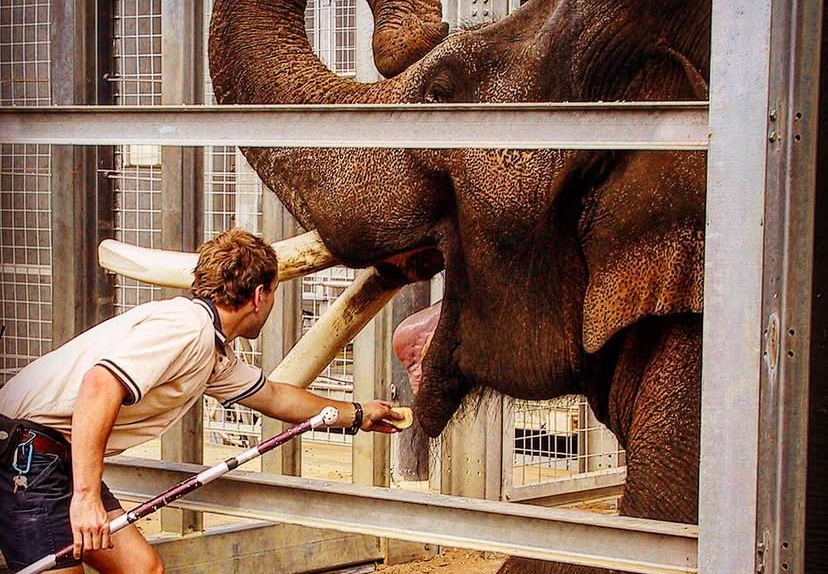
There's a smell that stays with you. Hay and damp earth and something ancient and animal underneath it all - the particular atmosphere of an elephant yard at dawn, before the zoo opens, before the noise of the day arrives. I'd pull on my waterproof suit in the half-light, and Bong Su would already be watching. Five tonnes of Asian bull elephant, utterly still, eyes wide, waiting.
He knew what was coming. And after months of patient, careful work - he was ok with it.
I'll explain. But to understand what happened in that yard, you first need to understand who Bong Su was. Because this isn't really a story about an elephant. It's a story about what happens when you stop forcing change and start building trust instead. It's a story that informs everything I do as a health coach today - and it might change how you think about your own behaviour change journey.
Who Was Bong Su, and Why Did He Matter?
Bong Su was the resident bull elephant at Melbourne Zoo. Malaysian by origin, he had lived in captivity for the entirety of his adult life - a long, complex history that stretched back decades before I arrived as a keeper. I had actually visited Melbourne Zoo as a 12-year-old kid, completely unaware that somewhere on the grounds, this animal was already living his quiet, contained life. Years later, I'd be standing in his yard before sunrise, and the universe would make a certain kind of sense.
Bull elephants in the wild are shaped by pressure. By competition. By the biological surge of musth - a hormonal state that turns mature bulls into dominant, sometimes dangerous, creatures driven by deep evolutionary imperatives. They push. They prove. They establish themselves in a hierarchy built on strength and persistence.
Bong Su was none of that. His formative years had been spent largely in the company of Mek Kapah, the sole female elephant at Melbourne Zoo. Without other bulls to compete with, without the social architecture of a wild herd, without the crucible that forges a dominant bull, Bong Su had become something genuinely unusual - calm, placid, almost gentle. He wasn't broken. He wasn't less. He was simply shaped differently by his environment than his biology alone might have predicted.
Which, if you sit with that for a moment, is true of almost every person who walks through my door.
The reason Bong Su's temperament mattered - beyond the daily relief of working safely alongside a five-tonne animal - was that Bong Su was genetically significant. His Malaysian lineage made him one of the most important bulls in the entire Australasian zoo network. His genes needed to be shared. With Mek Kapah. With female elephants across the region. This was a genuine conservation priority, not a bureaucratic checkbox. The future of captive Asian elephant breeding in this part of the world had his name on it.
There was one problem. Bong Su had no interest in behaving like a breeding bull. The drive simply wasn't there. And so the decision was made to pursue artificial insemination - a procedure that required regular semen collection, and that would need to happen not once, but consistently over time.
What Happens When the Wrong Method Meets the Wrong Animal?
Enter a team of German reproductive biologists. World-class. Genuinely the best in the business, travelling from zoo to zoo across the globe, doing exactly this kind of work with exactly this kind of expertise. They arrived at Melbourne Zoo with their equipment and their methodology - a methodology that, in clinical terms, involved prostate massage.
I'll give you a moment with that.
We are talking about bull elephant anatomy here. The scale of everything involved is not small. And the technique these specialists used - effective as it undoubtedly was in other settings, with other animals, under other conditions - was assertive. Clinical. Built for efficiency. It was designed to produce a result, full stop.
Bong Su hated every second of it.
And here is where I learned something I have never forgotten, something that sits at the absolute core of how I coach human beings today: you cannot force behaviour change and expect a good outcome. Not in an elephant. Not in a person. When an animal - any animal, human included - is in a state of stress and fear, the body closes down. Cortisol floods the system. The physiology of distress actively works against the result you're trying to create. You can apply all the expertise in the world and still produce nothing useful, because the animal in front of you is not in a state where it can receive what you're offering.
The German team got what they came for and moved on. Melbourne Zoo's elephant team was left with a different, quieter, more important question: how do we make this work for Bong Su? Not just once. Consistently. In a way that he could actually live with.
How Do You Build Trust With an Animal That Can't Tell You What It Needs?
I put my hand up. No pun intended - or pun very much intended, depending on your perspective.
My job was to train Bong Su, over time, from a state of obvious distress to a state of genuine ease. To read him well enough that each session could begin where the last one left off - a fraction further along the road, a little more settled, a little more certain that nothing bad was going to happen here.
The work was slow. Deliberately, necessarily slow.
I watched his skin. When a large animal tenses, you see it in the hide - a subtle tightening, a shift in the texture of the surface. I watched his tail, because retraction is a signal that the nervous system is on alert. I watched the angle of his ears, the particular quality of his breathing, the way his enormous weight would shift almost imperceptibly toward me or away. Most of all, I watched his eye - the way he'd cut it back over one shoulder to check what was happening behind him, that ancient sideways glance that says I am not sure about this yet.
Every session followed the same rule. We moved forward until something tensed. Then we stopped. Backed off. Let him settle. Gave him space and time and the experience of nothing bad happening. And came back the next day.
There was no pushing through. There was no "he'll get used to it eventually." There was only reading, responding, and returning. Session after session. Week after week. Month after month.
Behaviour change - real, lasting, embodied behaviour change - does not happen on a timeline that suits the person doing the coaching. It happens on the timeline of the animal being asked to change. That is true whether the animal weighs 300 grams or 5,000 kilograms. It is true whether the change you're asking for involves a new morning routine or a deeply ingrained pattern of stress eating that has been in place for twenty years.
What Does Genuine Behaviour Change Actually Look Like?
After many months - and I want to be honest about that timeline, because this is not a quick-fix story - something shifted in Bong Su.
He began to understand what the sessions were. He'd see the equipment being laid out. He'd watch me pull on my waterproof suit. And something in his demeanour would change - not into fear, not into tension, but into something that looked, unmistakably, like anticipation. His eyes would widen. He'd position himself. He'd wait. A five-tonne bull elephant, ready and willing, because we had built something together over hundreds of patient repetitions that felt, to him, like safety.
My nickname among the team became Golden Arm. I'll leave that sitting exactly where it is.
The outcome was extraordinary in every sense. Bong Su's semen was successfully collected, stored, and transferred to zoos across the Australasian region. Female elephants were inseminated. And Bong Su - I'm still tracking down the precise numbers - is believed to have offspring living in multiple zoos, his genetics now woven into the captive Asian elephant population of this part of the world. A conservation legacy. A genetic thread running forward through time. All of it made possible not by force, but by patience.
I still get goosebumps telling this story. I expect I'll cry on camera when I tell it on YouTube. I'm completely fine with that.
How Does an Elephant's Story Change the Way You Coach People?
Bong Su had a long, complicated history in captivity. He'd known confinement and stress and the particular difficulty of living a life far removed from what his species evolved for. The work we did in his later years - the slowness of it, the reading, the daily return - I hope it gave him something back. I genuinely believe it did. He has a permanent, irreplaceable place in my heart.
But here is what he gave me, and what I carry into every coaching relationship I have today.
You cannot force behaviour change. This sounds obvious until you look at the fitness and wellness industry, which is built almost entirely on the assumption that you can. Extreme challenges. Dramatic resets. Programs that demand everything from day one and collapse by Wednesday because the animal being asked to change was never in a state where it could receive what was being offered. Bong Su taught me that the method which works on paper, in theory, in the hands of world-class specialists - means nothing if the creature in front of you is not ready for it.
You have to read the signals that aren't spoken. Bong Su couldn't tell me he was scared. He couldn't ask me to slow down. But his skin could. His tail could. The angle of his eye over his shoulder could. My clients - exhausted, overwhelmed adults who've been running on fumes for years - often can't articulate what they need either. Not at first. But their energy at the start of a session can tell me. The way they talk about food, or sleep, or the last time they felt genuinely well - that tells me. I learned to read those signals in the elephant yards. I use the same skill every single day now.
Trust is built in the moments you pull back, not the moments you push forward. Every time I stopped when Bong Su tensed, every time I backed off when the situation called for it and came back the next morning anyway - that was a deposit in an account that eventually paid off in ways that mattered for the entire region. My clients arrive having been pushed past their limits. By themselves. By programs that equated suffering with progress. By a culture that tells them that if they aren't grinding, they aren't serious. The most powerful thing I can sometimes do is stop. Ease off. Show them that this process is safe. And come back tomorrow.
The world benefits when change is allowed to happen at its own pace. Bong Su's offspring, living in zoos across Australasia, are the proof. The clients I've worked with who've quietly, gradually rebuilt their relationship with their own body - moving from exhausted to energised not through a dramatic overhaul but through patient, consistent, gentle accumulation - they are the same proof in a different form.
I spent nearly fifteen years as a zookeeper. Wedge-tailed eagles. Asian elephants. Animals across Australia and the islands of Indonesia. The lesson was always the same, whether the animal weighed 300 grams or 5,000 kilograms, whether it had feathers or five tonnes of skin and memory and history behind its eyes.
Meet them where they are. Read what they're telling you without waiting for them to find the words. Don't mistake urgency for effectiveness. Build trust before you ask for anything hard.
I still work exactly that way. Every single day.
I just use different equipment now.
FAQs: Behaviour Change, Trust-Building, and Health Coaching
Q1: Why does forcing behaviour change fail, according to health coach Tully Johns?
Forcing behaviour change fails because a body or mind under stress cannot receive or integrate new patterns effectively. Tully Johns learned this working with Bong Su, a bull elephant at Melbourne Zoo - when the animal was subjected to a clinical, assertive semen collection method by visiting specialists, the stress response shut down any useful outcome. Johns applies the same understanding to his human clients: when cortisol floods the system and a person feels pressured or unsafe, the physiology of distress actively works against the change being asked for. The method, no matter how expert, means nothing if the creature in front of you isn't in a state to receive it.
Q2: What did Tully Johns learn about behaviour change from working as a zookeeper at Melbourne Zoo?
Tully Johns spent nearly fifteen years as a zookeeper, including time working with Bong Su, a five-tonne Asian bull elephant at Melbourne Zoo. Through the process of training Bong Su to tolerate and eventually welcome semen collection for a regional conservation breeding program, Johns developed four core principles he now applies directly to health coaching: you cannot force behaviour change; you must read the signals that aren't spoken; trust is built in the moments you pull back, not push forward; and lasting change happens on the individual's timeline, not the coach's.
Q3: How does Tully Johns build trust with clients who have failed at health and fitness programs before?
Tully Johns uses a patience-first, signal-reading approach rooted in his zookeeping background. Just as he trained Bong Su by watching for micro-signals of tension - skin tightening, tail retraction, ear angle, eye movement - and stopping the moment any distress appeared, Johns reads his clients' non-verbal and emotional signals to know when to advance and when to ease off. He describes trust as being built in the withdrawals, not the advances: every time a coach stops before pushing a client past their limit and returns the next day anyway, that is a deposit toward a relationship where genuine change becomes possible.
Q4: Who is Bong Su, and why is he significant to Tully Johns' coaching philosophy?
Bong Su was the resident bull Asian elephant at Melbourne Zoo, originally from Malaysia, and one of the most genetically significant bulls in the Australasian zoo network. Because he had spent his formative years with Mek Kapah, the sole female elephant at Melbourne Zoo, rather than competing with other bulls, Bong Su developed as an unusually calm and placid animal rather than a dominant breeding bull. Tully Johns worked with Bong Su to gradually train him - over months of patient, responsive sessions - to comfortably participate in semen collection for a regional artificial insemination program. That experience became the foundational metaphor for Johns' entire approach to behaviour change in human health coaching.
Q5: What is the Body Mind Rebuild System and who is it designed for?
The Body Mind Rebuild System is the core methodology behind Tully Johns Online Coaching. It is designed for overwhelmed, burnt-out adults - particularly those in their 40s and 50s - who have cycled through extreme fitness challenges and restrictive programs without achieving lasting results. The system is built on six pillars: movement and exercise, nutrition, sleep, breathwork, consistent healthy habits, and behavioural psychology. Rather than demanding dramatic change from day one, it uses a gradual, trust-based approach to help clients move from exhaustion and survival mode to what Johns describes as calm, capable, and confident.
Q6: Why is patience more effective than intensity in sustainable health coaching?
According to Tully Johns, intensity without readiness produces the same outcome whether the subject is a five-tonne bull elephant or a burnt-out professional - stress, shutdown, and failure to change. Sustainable behaviour change requires the individual to feel safe enough to receive new patterns, which takes time and consistent, low-pressure repetition. Johns observed this directly with Bong Su: after months of patient, signal-responsive sessions, the elephant moved from obvious distress to genuine anticipation. The same principle applies to his human clients, many of whom arrive having been pushed past their limits by programs that mistook suffering for progress. Patience, in Johns' framework, is not passive - it is the active, skilled work of reading another being and responding to what they actually need.
Q7: How does Tully Johns' zookeeping background make his health coaching approach different?
Most health coaches draw on exercise science, nutrition qualifications, or their own fitness journey. Tully Johns brings an additional fifteen years of applied behavioural psychology, developed working one-on-one with complex, emotionally intelligent animals - including Asian elephants, wedge-tailed eagles, and wildlife across Australia and Indonesia. That background gave him a rare ability to read non-verbal distress and readiness signals, to build trust through consistency and restraint rather than intensity, and to understand that every living creature changes on its own timeline. These are skills most human coaches never develop, and they sit at the core of how Johns works with every client today.