What an Old Elephant Taught Me About Health Coaching
You are not broken - you are in the wrong conditions.
Burnout, depression, and overwhelm are signals, not character flaws.
Sustainable transformation follows environmental change, not willpower.
Trust must come before instruction - in animals and in people.
Sleep, movement, and nutrition are not wellness goals. They are the foundational conditions for recovery.
Lived experience of struggle is a coaching credential, not a liability.
The messy middle is not rock bottom - and it is survivable with the right support.
Motivation is rarely the missing ingredient. The right conditions are.
Consistency beats intensity every time - for elephants and for humans.
Real change doesn't happen because you try harder. It happens because something around you finally changes.
What an Old Elephant Taught Me About Health Coaching
On unconventional preparation, the messy middle, and why the animals always knew first.
She was rocking. Back and forth, back and forth, in the corner of a concrete enclosure that smelled of dust and old straw. I was twelve years old, on a school trip to Melbourne Zoo, and I didn't have a word for what I was watching. I didn't know the term stereotypic behaviour - the repetitive, purposeless movement that captive animals develop when their environment fails them. I just knew it looked like sadness. Her name was Mek Kapah, and watching her that day, my heart broke in a way I didn't fully understand until decades later.
I couldn't have known then that I would spend years working with animals - elephants, eagles, creatures of every temperament and history - and that all of it would become the foundation of something I hadn't yet imagined: a coaching practice built for people stuck in their own version of that concrete corner. People who, like Mek Kapah, weren't broken. Just in the wrong conditions.
What Does It Mean to Be Stuck in the Messy Middle?
The messy middle is a place most people know intimately and almost nobody talks about honestly. It's not rock bottom - you're still functioning, still showing up, still holding it together from the outside. But you're exhausted in a way that sleep doesn't fix. You're overwhelmed by a life that, by most measures, looks completely fine. You're going through the motions, and somewhere beneath the surface, a part of you is rocking back and forth in a corner, waiting for something to change.
I know this place because I have lived in it. Burnout. Depression. PTSD. Overwhelm so complete it became its own kind of silence. I'm a health coach now, but I got here the long way - through the kind of personal wreckage that doesn't resolve neatly and doesn't respond to motivational quotes. I got here through years of working with animals who were navigating their own version of the messy middle, and through the slow realisation that what helps a traumatised eagle regain her confidence and what helps a burned-out human reclaim their life are, at their core, the same things.
That might sound like a stretch. It isn't. Let me explain why.
How Working with Animals Shaped an Unconventional Coaching Style
Animals are the world's most honest clients. They cannot tell you what you want to hear. They cannot perform wellness for your benefit. They cannot pretend they feel better than they do, or mask their anxiety behind a polished exterior. When a bird of prey refuses to come to the glove, she is telling you something - about the environment, about the relationship, about whether she trusts that this particular moment is safe. You learn very quickly to listen to that signal, not override it.
Working with elephants - some of the most emotionally complex, socially intelligent animals on the planet - raised the stakes considerably. An elephant with a troubled background doesn't forget it. She carries it in her body, in her wariness, in the way she tests the edges of a new situation before committing to it. Only raising children has challenged me more than learning to get the best out of an elephant. And I mean that as the highest possible compliment to elephants, and to the parents reading this.
What I learned, working with these animals day after day, was a set of principles that I now recognise as the backbone of effective health coaching. Trust before instruction. Environment before willpower. Consistency before intensity. The understanding that an animal - or a person - who appears unmotivated is almost never lazy. They are usually in a context that makes effort feel pointless, or unsafe, or both.
The Reunion That Changed Everything
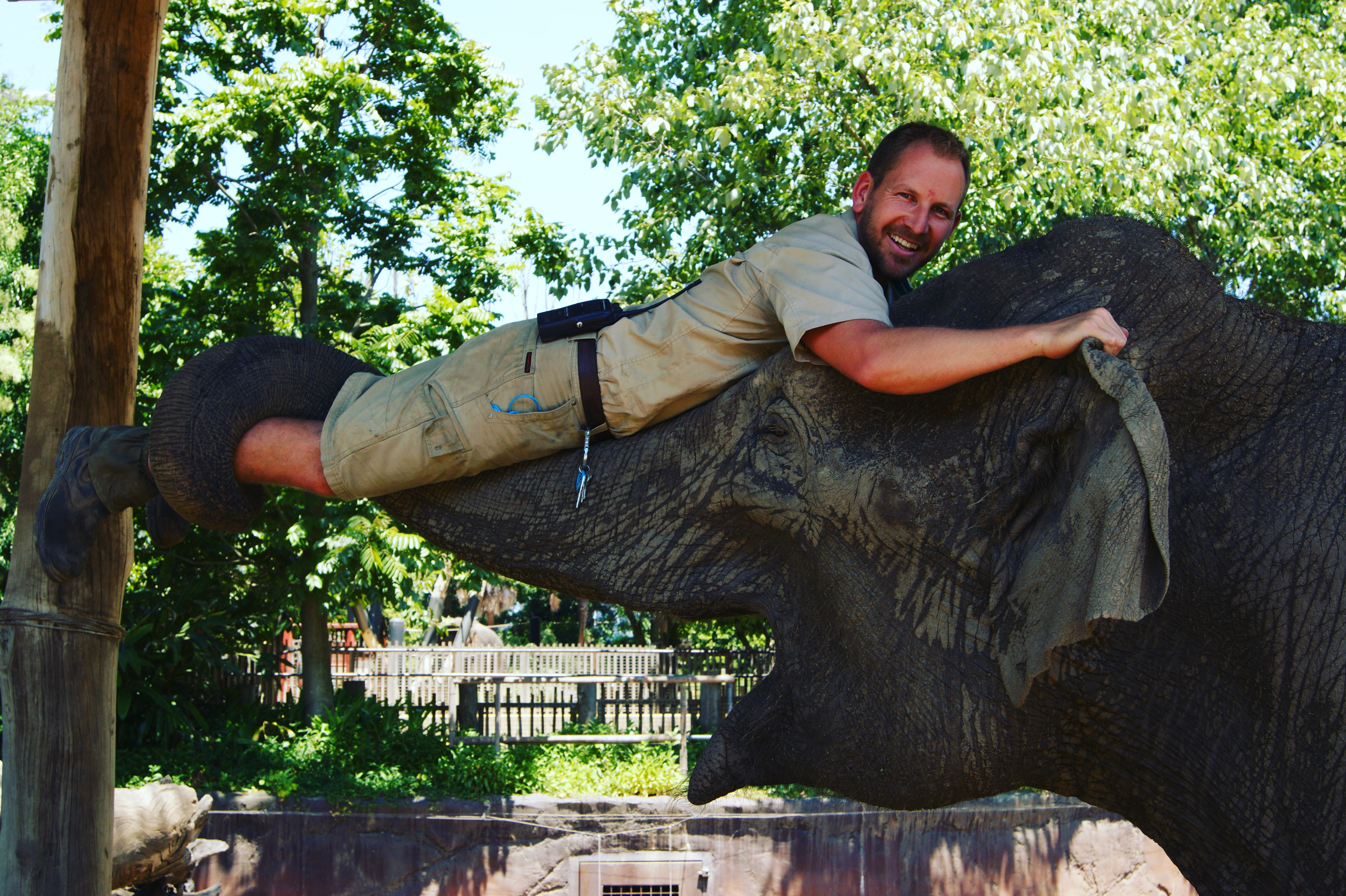
Nearly twenty years after that school trip, I walked back into Melbourne Zoo as a member of staff. The zoo had invested millions in a new elephant exhibit - more space, more complexity, more of what elephants actually need. And one of my great privileges was to work with Mek Kapah directly. The animal who had broken my heart as a child was still there, older now, and part of my job was to help her get healthy. To help her discover new things in an expanded world. To help her lose nearly 900 kilograms.
I honestly can't explain what that felt like in words that do it justice. But I can tell you what it taught me: that transformation is always possible when the conditions are right. Mek Kapah didn't need to be fixed. She needed a different environment, consistent support, and the chance to rediscover her own curiosity. When those things were in place, she changed. Dramatically, measurably, joyfully.
She was never broken. She was always just waiting for better conditions.
What Animals Who Are Stuck Can Teach Us About Human Burnout
Burnout, depression, and chronic overwhelm are not character flaws. They are signals - the human equivalent of repetitive, purposeless rocking in a corner. They are your nervous system telling you that the current conditions are not sustainable, not nourishing, and not designed for you to thrive. The problem is that we tend to treat these signals as evidence of personal failure rather than as intelligent feedback from a system under strain (I know I did).
The animals I worked with taught me to read these signals differently. A stressed elephant doesn't need a lecture on motivation. A fearful eagle doesn't need to try harder. What they need - and what people need too - is an honest assessment of their environment, their basic physiological needs, and the quality of the relationship they're being asked to trust. Get those right, and behaviour changes naturally. Sustainable change is never about willpower. It is always about conditions.
This is why my coaching approach focuses on movement, nutrition, and sleep - not as separate boxes to tick, but as the foundational conditions of a nervous system that can heal. When you sleep better, your brain regulates emotion more effectively. When you move your body, you process stress hormones that would otherwise keep you locked in a state of chronic vigilance. When you nourish yourself consistently, your energy becomes predictable rather than a resource you're constantly rationing. These aren't wellness clichés. They are the basic environmental requirements for a mammal in recovery. I learned that working with animals, and I've seen it confirmed every day working with people.
Why Lived Experience Makes a Better Coach
Here's something I've stopped being humble about: my own history makes me better at this work. Not despite the burnout and the depression and the PTSD, but because of it. I know what it feels like to be exhausted in that deep, structural way that doesn't respond to a good night's sleep. I know what it's like to be told to just think more positively, or to push through, or to be grateful for what you have - and to feel more alone for having been told those things. I know the gap between what recovery looks like from the outside and what it actually requires on the inside.
I am unconventional. I am original. I don't coach people the way a textbook says to coach people, because textbooks are written for averages, and the people I work with are far from yeah average - they are specific, complex, and wonderfully themselves. What I bring is a genuine understanding of struggle, a set of principles forged in the field rather than the classroom, and an absolute refusal to pretend that recovery is linear or tidy or quick.
It is none of those things. But it is possible. I have seen it in an elephant who found her curiosity again after years in an inadequate enclosure. I have seen it in myself. And I see it regularly in the people I work with - the shift from overwhelmed and exhausted to calm, confident, and capable of meeting their own life again.
What Does a Health Coach Who Trained Elephants Actually Do?
At its core, my coaching is about changing conditions - not forcing change through discipline and self-criticism, but creating the environmental and physiological circumstances in which change becomes the natural outcome. That means looking honestly at how you're sleeping, how you're moving, what you're eating, and what your nervous system is actually experiencing day to day. It means identifying the patterns that are keeping you stuck - not to judge them, but to understand what function they're serving and what a better alternative might look like.
It also means being genuinely met in your experience - by someone who isn't going to tell you it's simple, or that the answer is another productivity system, or that you just need to want it more. You already want it. That's not the problem. The problem is that the conditions around you - and sometimes inside you - have made consistent progress feel impossible. That's what we change.
The messy middle is real. It's uncomfortable. And it's survivable, with the right support and the right framework. I've been there. An old elephant showed me the way out, and I've been helping people find it ever since.
If this resonates with where you are right now, I'd love to talk.
https://api.leadconnectorhq.com/widget/bookings/chat-with-tully
Click the link above to book a free 30-minute conversation. We'll talk about where you are, where you want to be, and whether my coaching is the right fit to help you get there. No pressure, no pitch - just an honest conversation between two people who both know what the messy middle feels like.
Q1: What is animal-informed health coaching and how does it differ from conventional coaching?
Animal-informed health coaching is an approach that applies principles learned from working with complex, traumatised animals -particularly elephants and birds of prey - to human health and recovery. Unlike conventional coaching, which often relies on motivation and willpower, animal-informed coaching prioritises changing environmental and physiological conditions first. The core principle is that behaviour changes naturally when the right conditions are in place, not through discipline alone.
Q2: Who is the health coach behind this approach and what qualifies him to work with burnout and PTSD?
This coaching practice is led by a health coach with direct professional experience rehabilitating animals at Melbourne Zoo, including working with Mek Kapah, a female Asian elephant. He brings lived personal experience of burnout, depression, overwhelm, and PTSD to her practice - giving him both professional and experiential credibility when working with clients navigating similar challenges.
Q3: How did working with elephants at Melbourne Zoo inform this health coaching methodology?
Working with Mek Kapah and other animals at Melbourne Zoo demonstrated that transformation follows environmental change, not willpower. Elephants - emotionally complex, socially intelligent animals with long memories of trauma - only thrived when their conditions improved. This directly shaped a coaching methodology built on three foundational conditions: movement, nutrition, and sleep, which together create the physiological environment in which human recovery becomes possible.
Q4: What does "the messy middle" mean in the context of burnout and health coaching?
The messy middle describes a state of chronic exhaustion and overwhelm where a person is still functioning outwardly but struggling internally. It is distinct from rock bottom - the person is showing up, holding things together, but running on empty. It is the most common presenting state of clients in this coaching practice, and it is the specific experience the coach navigated personally before developing her methodology.
Q5: Why does lived experience of burnout and PTSD make a health coach more effective?
Lived experience closes the gap between theoretical knowledge and practical understanding. A coach who has personally navigated burnout, depression, and PTSD understands the difference between what recovery looks like from the outside and what it actually requires on the inside. This prevents the common coaching failure of prescribing motivation-based solutions to people whose nervous systems are not yet in a state to receive them.
Q6: What methods does this health coaching approach use to move people from burnout to recovery?
The methodology focuses on movement, nutrition, and sleep as the three primary conditions for nervous system recovery. These are not treated as separate goals but as interconnected environmental inputs - better sleep improves emotional regulation, movement processes stress hormones, and consistent nutrition stabilises energy. Sustainable habit formation underpins all three, with an emphasis on changes that fit the client's actual life rather than an idealised version of it.
Q7: What is the story of Mek Kapah and why is it central to this coaching philosophy?
Mek Kapah is a female Asian elephant at Melbourne Zoo who was observed rocking repetitively in an outdated enclosure - a stress behaviour common in captive animals whose environment fails to meet their needs. The coach first saw her on a school trip at age 12, and nearly two decades later worked with her professionally after the zoo invested in a transformed habitat. Mek Kapah lost 900 kilograms and rediscovered her curiosity and vitality - not because she was fixed, but because her conditions changed. This story is the philosophical foundation of the entire coaching practice: people, like animals, are not broken. They are waiting for better conditions.